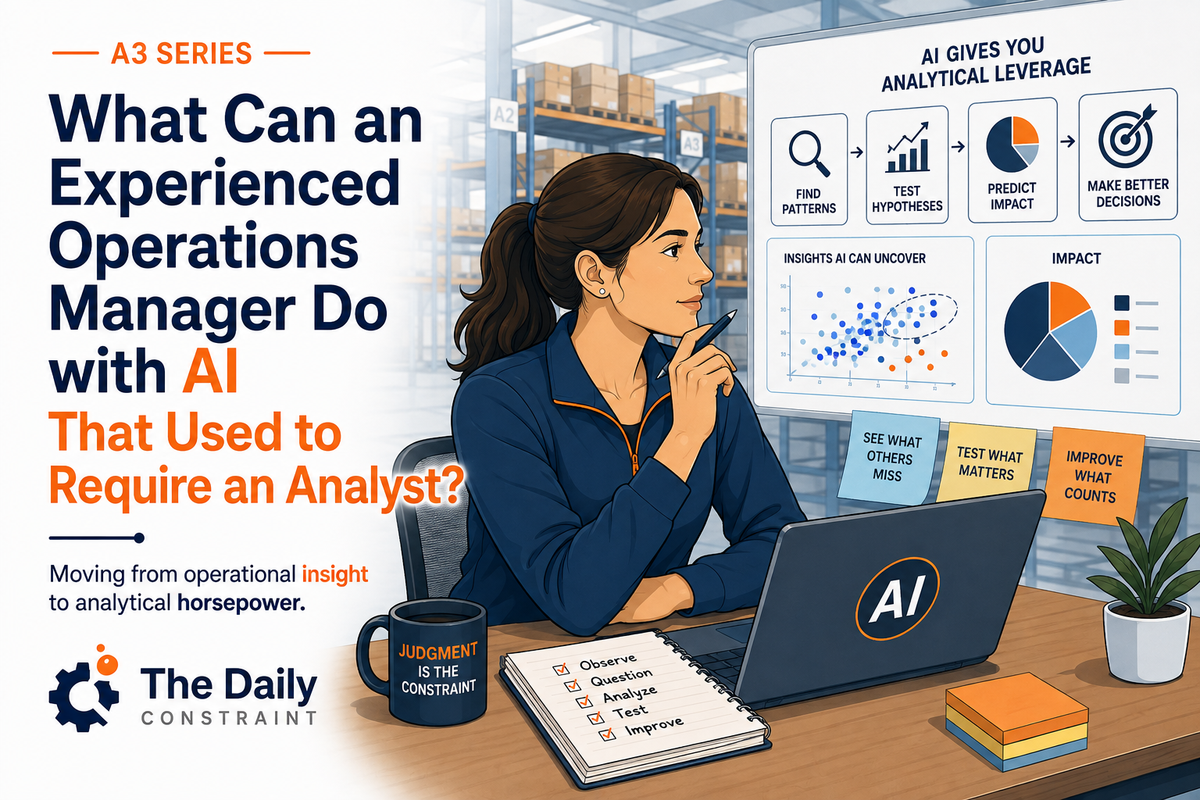
What Can an Experienced Operations Manager Do with AI That Used to Require an Analyst?
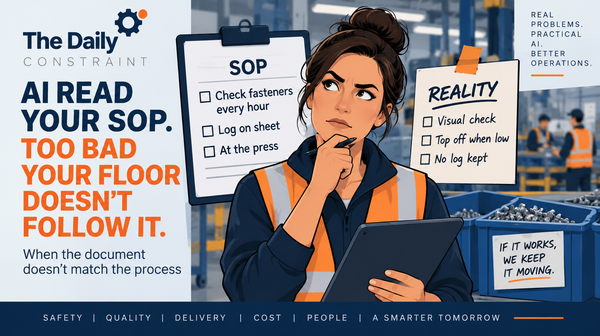
You already know AI isn't here to replace you. We spent six articles proving that, from breaking down a messy shift handoff to translating precise instructions for a crew that doesn't share your first language. If you haven't read that series yet, start with The Irreplaceable Operations Manager and come back. Twenty minutes, and it'll change how you think about your next Monday.
This series is not that.
The first series was about trust. This one assumes you already have it, and it asks a harder question.
What can an experienced operations professional do with AI that used to require more time, more specialized expertise, better analytical tools, or another person entirely?
That's the whole series in one sentence. Not “can AI draft an email for me?” Instead, it answers this: “Can AI hand you analytical horsepower you would otherwise have had to beg, borrow, or sell your soul to an engineer for?”
The First Series Got You in the Door
Series one was deliberately simple. Shift notes. Workarounds. Handoffs. Translation. Tasks you already do every week, made a little faster and a little sharper with AI sitting next to you.
That was the point. Nobody trusts a tool they've never touched. You had to use it on something small before you'd trust it with something that matters.
Hopefully, you’ve used it.
Now it's time to use AI for something that matters.
This Series Runs Different
Fair warning: this material is drier. We're talking hypothesis testing, constraint migration, and experimental design instead of quick prompts for your next shift note. That's not a bug. It's the whole reason this series exists.
You already know how to read a floor most people can't even see. This series is built to respect that, article by article, without stopping every paragraph to check if you're still smiling.
The Bar We're Setting
Every article in this series has to clear one test: could an experienced operations manager figure this out alone, in ten focused minutes?
If yes, it doesn't belong here. You don't need me to explain what a Pareto chart is. You've built one before with a marker and a whiteboard during a shift-change meeting.
If no, that's the article. The gap between “I could technically do this myself” and “I would need an analyst, a data scientist, or six uninterrupted hours I do not have” is exactly where this series lives.
That gap isn't hypothetical. Recent research out of MIT Sloan makes a similar case at the level of the entire labor market: AI is more likely to complement specialized human judgment than replace it, especially in work that depends on context, experience, and expertise.
That's a fair description of what you do all shift long. This series is the floor-level version of that finding. Your judgment remains the constraint that matters. AI is what removes the other constraints, the ones that used to sit between your judgment and the answer: the six hours, the spreadsheet gymnastics, the analyst who's three weeks out on other projects.
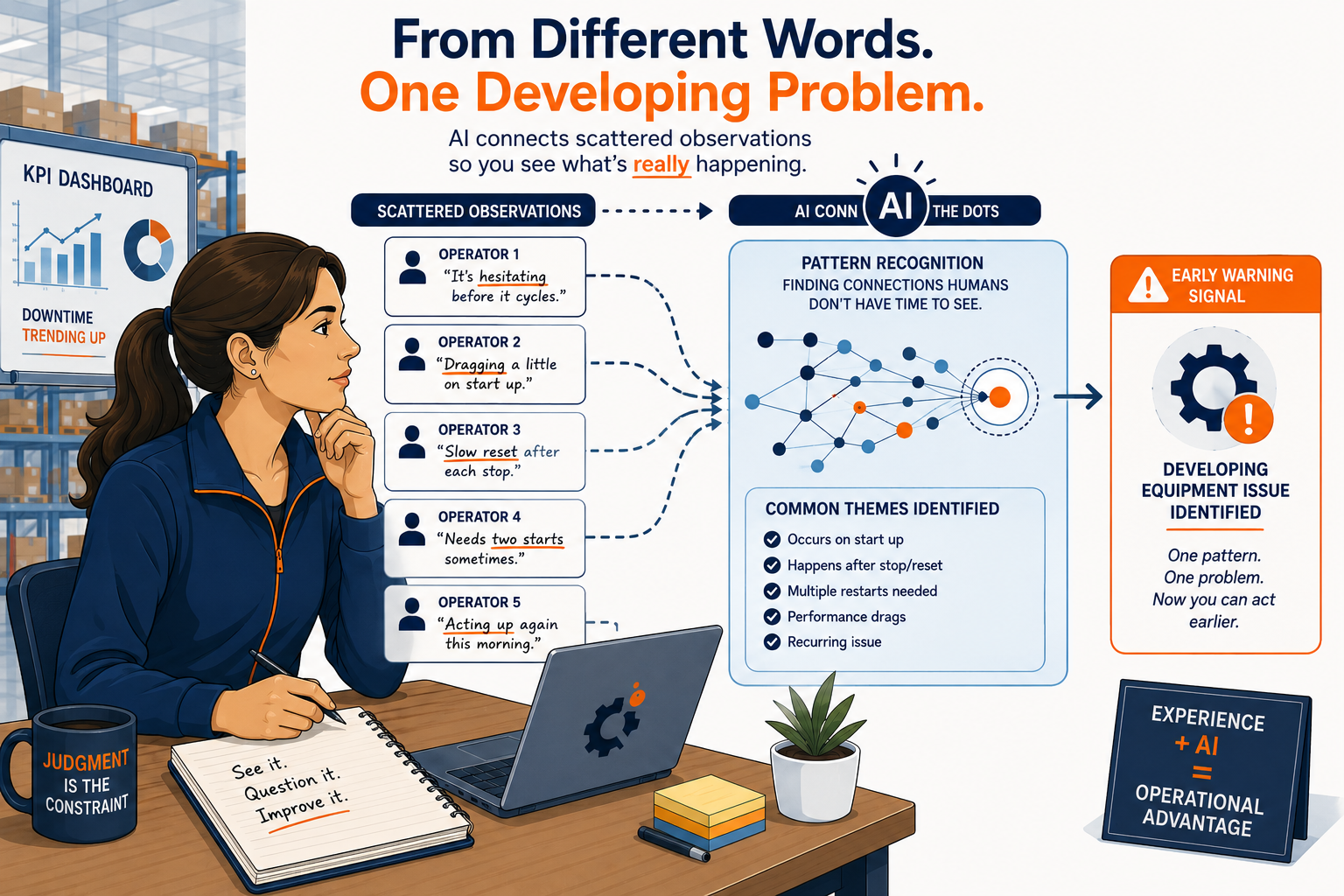
Here's what that gap looks like. Say you pull six months of shift handoffs and maintenance notes. Buried there, five different operators have described the same developing failure in five different ways: hesitating, dragging, slow reset, needs two starts, acting up again. A spreadsheet doesn't know those five phrases might be the same early warning sign. It just sees five unrelated comments and moves on.
A language model, pointed at that same pile of notes and asked the right question, potentially can connect them. That's the shift this series is chasing, not “AI can summarize your shift notes,” which you already knew, but “can AI turn unstructured operational language into an early-warning signal you'd otherwise never see,” which is a completely different, much more useful question.
Five Articles, in the Order You'd Operationally Use Them
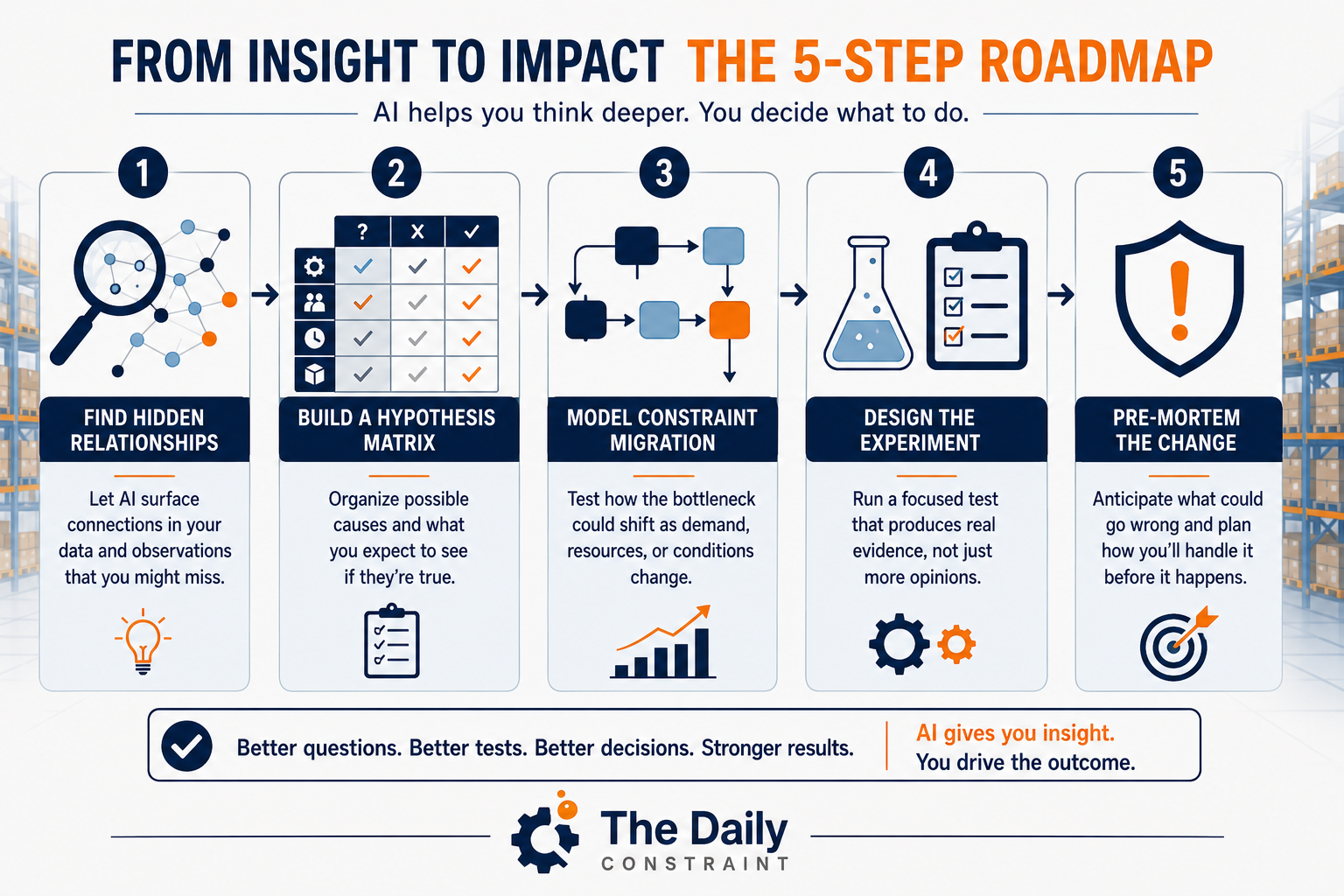
These aren't five random AI tricks stacked in whatever order occurred to me. They follow the real sequence of a serious improvement project, the same one you already run in your head every time something breaks and you have to fix it right instead of just fixing it fast: understand what's happening, diagnose why, model what your fix will break somewhere else, test it before you commit, then stress-test it one more time before you touch the real process.
● Find the relationships your dashboard is hiding. Your KPI dashboard tells you Line 4's downtime is high. It doesn't tell you that failures cluster in the first ninety minutes after a changeover, on product family B, when staffing dips below a certain headcount. AI can find that interaction. Your dashboard can't, because nobody built it to look for combinations, only totals.
● Build a hypothesis matrix instead of running another 5 Whys. ASQ has a solid rundown of formal root cause methods if you want the textbook version. We're going further: instead of letting AI hand you a root cause, it helps you hold several suspects at once and rule them out systematically, the way an investigator works a case, not the way a form gets filled out.
● Check what your fix breaks somewhere else, before you make it. Every operations manager who's studied Theory of Constraints knows the bottleneck moves the moment you fix it. AI can model where it moves to before you spend a dime finding out the hard way, on the floor, in real time.
● Design the experiment that tests your countermeasure. Baseline, control variables, confounders, stop conditions, sample size. The stuff that separates “I think this worked” from “I can prove this worked,” built in minutes instead of an afternoon you don't have to spare.
● Run a pre-mortem before you touch the process. Safety, quality, delivery, cost, people, downstream constraints. Attack your own plan from every angle it could fail, before the floor finds those angles for you, on a Tuesday, in front of your boss.
Notice what's missing from that list: nothing here is “ask AI what a bottleneck is.” Every one of these assumes you already know your Lean fundamentals cold. What you're short on isn't concepts. It's time and tooling to run the analysis those concepts demand, on top of an actual full-time job running a floor.
Why This Isn't Hype
You're skeptical of AI content. Good. You should be. Most of it is written by people who've never stood on a production floor, promising that a chatbot will fix problems that require a wrench, a headcount, or a hard conversation with a supplier.
This series won't do that. Every article is going to include a real, structured prompt you can copy and run against your own data today, not a vague suggestion to “leverage AI for insights.” If an article doesn't leave you with something you can use on your next shift, then the article failed, and you should comment below and say so.
I'll also tell you where AI runs out of road. It can find a correlation. It cannot walk your floor, smell a bearing before it fails, or read the look on an operator's face when they say a machine is “fine” and mean the opposite. Every article in this series draws that line on purpose, because pretending the line doesn't exist is exactly the kind of overselling that got AI content a bad name on the floor in the first place.
What This Series Won't Do
It won't teach AI to run your operation for you. It won't hand you a root cause and tell you to trust it blindly, and if it ever tries to, that's the moment to stop and ask harder questions, not the moment to relax.
What it will do is give your experience somewhere new to point. You already know your floor better than any model ever will. This series just hands you a much better flashlight.
Next Up in the Series
Tomorrow, we start where every real investigation begins, with the data you already have, and the relationships buried inside it. Relationships and parallels your dashboard were never built to show you.
If Monday’s spreadsheet has ever made you say, “something's going on here, I just can't prove it,” that one's for you.
Subscribe to The Daily Constraint so it lands in your inbox the day it goes live. And when you read it, don't comment to say AI impressed you. Comment below to let me know whether it found something your dashboard never would have.