Will AI Soon Replace Operations Managers?
The end is coming! Bring out your dead-end career!
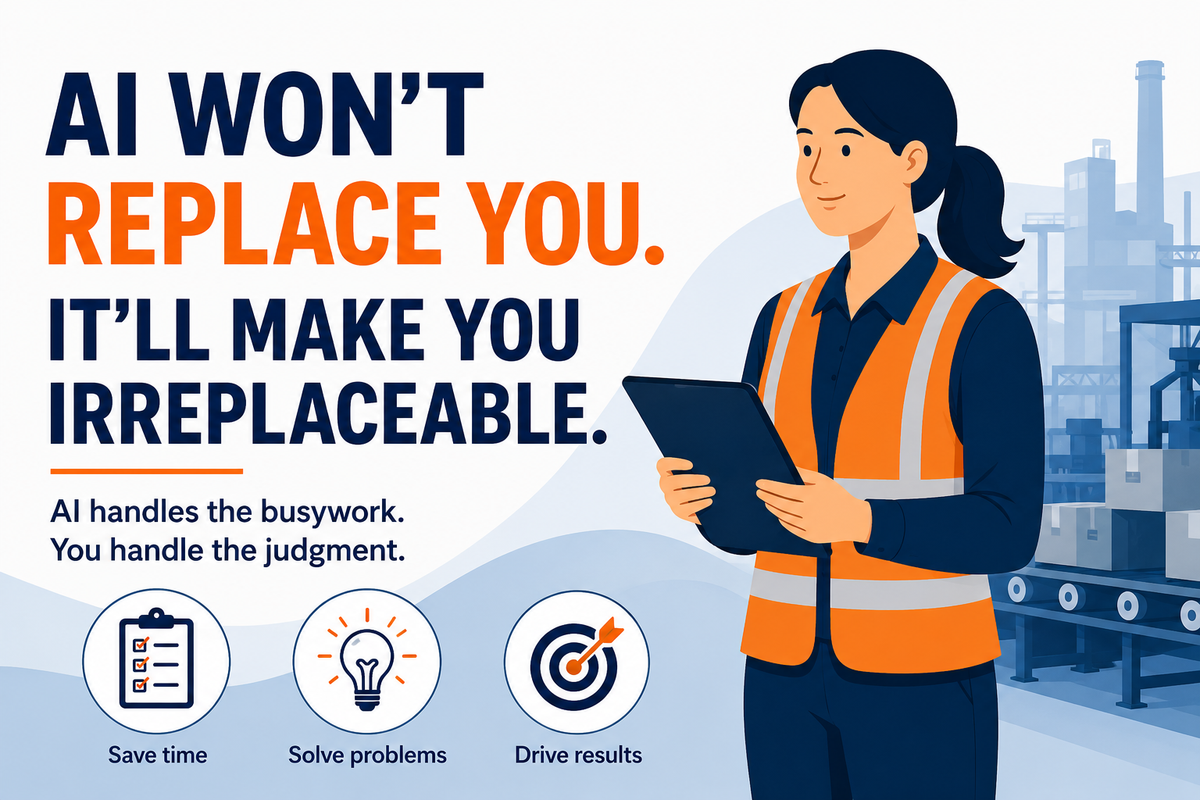
At least, that’s what you hear if you’re listening to the hype. Is AI powerful? You better bet it is. The real question on every OM’s mind, though, is this, “Am I going to be replaced by a computer?” The short answer is a resounding “No!”
The long answer is a little more complex.
There’s no doubt that AI has a lot to offer operations managers. It can be used for a wide range of tasks you do every single day.
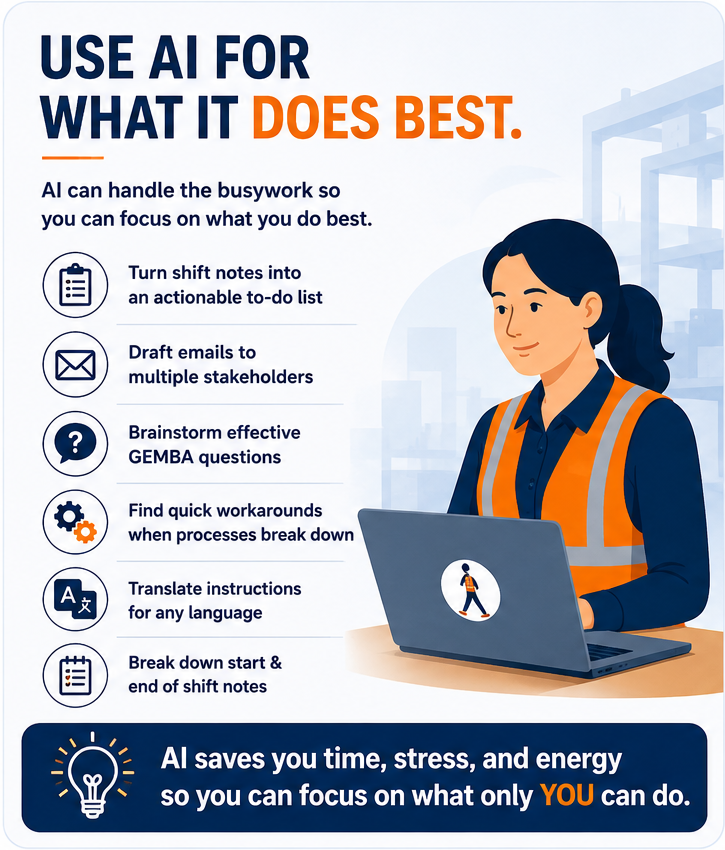
· Transform shift notes into an actionable “to do” list.
· Draft simultaneous email communication to multiple stakeholders.
· Brainstorm effective GEMBA questions.
· Breakdown start of shift notes and draft end of shift notes.
· Identify quick workarounds when processes suddenly break down.
· Translate precise instructions to employees who speak little English.
Each of those six is worth its own deep dive. Consider this the trailer. Future posts in this series will walk through exactly how to prompt AI for each one, step by step, so you’re not just nodding along. You’re actually using it on your next shift.
While these are all incredibly useful in the average shift and can save you time, stress, and energy, they are no replacement for your eyes, ears, and mind.
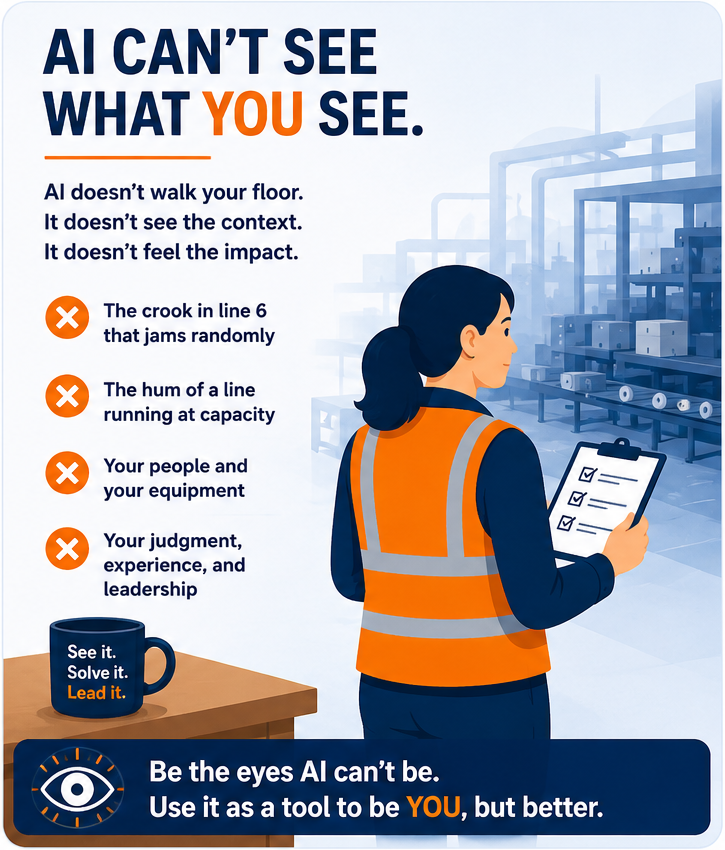
As an operations manager, you walk the floor every single day. You know the people on your team. You know the equipment in your building. You know, better than anyone, about the crook in line 6 that jams randomly when a stray piece of plastic wrap zooms by the photo eye, and other random equipment quirks every factory and warehouse has. Those are things AI can’t see and process the way you can. They give you an advantage AI will never supersede. At least, not any time soon.
Ultimately, you’re asking the wrong question. You shouldn’t ask if AI is going to replace you. The question you should be asking is this: “How can you USE AI to make yourself irreplaceable?”.
AI Can be as Simple or as Complex as You’d Like it to Be
You’ve probably seen all the commercials littering the World Wide Web via YouTube, Facebook, and other social media strongholds that present an aging professional who isn’t hip enough to keep up with AI and all the value it represents for streamlining projects.
Fuggedaboutit!
Those are people who work in the neat, orderly confines of an office-space. You work on a factory or warehouse floor. You gather a collection of sticky note disasters during your walk to the shift start-up area. That’s in addition to your own scribbled observations:
· 5S areas are disorderly.
· A pile of discarded packing materials near L7.
· There was an accident on Interstate that is likely to slow truck traffic and lead to employee tardiness.
· Why aren’t you hearing the hum of lines operating at capacity throughout the warehouse?
This is where AI can be a boon for your day and your career. Not the end of both. Even better? You don’t have to have a computer programming degree to make it work for you!
In fact, starting simple is the best way to begin to see, in real time, the benefits AI has to offer operations managers. It will also quickly show you why it isn’t likely to replace you too quickly either. Later, after you’ve mastered the art of “talking” to AI, then you can begin working on the more complex tasks. If that interests you. But you don’t need to learn coding for AI.
Communicating with AI
Almost every AI system has its own unique quirks and qualities. Chances are your organization has created its own AI system, or it is quickly coming up with policies related to what is and is not approved for work and what specific information you can share with AI. Before you do anything, familiarize yourself with the rules.
One thing you will quickly learn is that AI wants to be helpful. Sometimes, it’s a little too helpful. It will draw conclusions where you didn’t ask for them, unless you specifically ask it not to draw conclusions. This is a critical thing to remember when creating prompts.
What is a prompt?
That’s a good place to begin. A prompt is how you communicate with AI in the chat format. It looks like a Google search and functions in much the same way. You type in your query in the box.
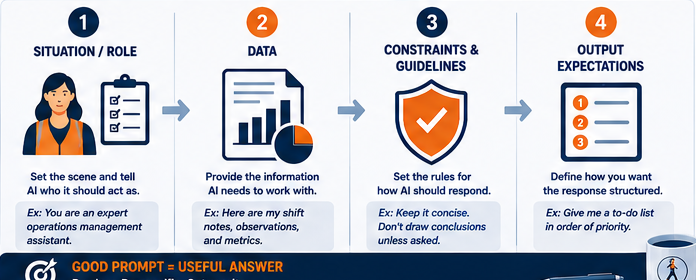
The key difference is that you must be extremely specific when communicating with AI. Don’t assume anything. A good prompt includes 4 key elements.
1. Situation/Role – the situation and who are what you want the AI to act as.
2. Data – the information the AI needs to address
3. Constraints and guidelines. The rules you want the interaction to function under.
4. Output expectations. How you want the conclusion structured.
A good guiderail is to ask for the response to be easily scannable, to avoid inserting context that does not exist, to avoid drawing conclusions unless specifically asked, and to keep responses brief unless additional context is asked for.
Caution.
Don’t take every response AI gives at face value. While it is important for you not to assume, AI often makes major assumptions.
Getting back to your morning walkthrough observations, sticky notes, scribbled notes, etc. Did you know that AI can be a force in helping you deal with them?
How often do you make it back to your desk, or what serves as your desk on your operations floor to discover that you have no idea where your head was when you made a certain note, or how to even organize these notes into a solid action plan for hour one? AI can help. Do the following.
· Arrange your notes so they can be neatly seen.
· Take our your phone and snap a photo of the entire pile of notes.
· Insert the photo into your AI chat box.
Then, you want to create the following prompt:
You are an expert operations management assistant. I am uploading a photo containing my handwritten sticky notes and scribbled notes from the floor.
Please analyze these notes and organize them into a clean, actionable shift-management plan. Structure your output using the exact sections below:
1. EXECUTIVE SUMMARY & URGENT PRIORITIES
- A concise summary of the core operational issues captured in the notes.
- The top 3 immediate priorities that require attention during this shift.
2. STAKEHOLDER COMMUNICATION PLAN
- A bulleted list of stakeholders who need to be informed based on these notes.
- For each stakeholder, specify exactly what they need to be informed of.
- Draft ready-to-send email templates for each stakeholder, leaving placeholders like [Name] where appropriate, formatted so I can quickly copy, review, and send them.
3. PRODUCTION DECISIONS & ESCALATION MATRIX
- A breakdown of production decisions that must be made based on the notes.
- For each decision, clearly state whether I (as the Operations Manager) have the authority to make it or if it must be escalated.
- If escalation is required, specify to whom it must be escalated and draft a concise escalation email template.
4. KEY OPERATIONAL DETAILS & IMMEDIATE CORRECTIVE ACTIONS
- Extract essential operational details, bottlenecks, or safety points of import.
- Provide a list of three possible, practical short-term corrective actions that can be taken immediately to stabilize the situation while further root-cause analysis takes place.
5. FOLLOW-UP & OPEN LOOPS
- Any unresolved questions, lingering uncertainties, or items requiring tracking for the next shift handoff.
It’s a long prompt, but it’s one you can create once, save, and use every day to get through the morning walkthrough. Some AI systems, Claude for example, allow you to create skills. Skills let you establish a specific “prompt” for all communications and interactions with you, but that’s once you have the basics down.
Think about how much time you spend each day working on these simple things that you observe and are informed about during your first 10-15 minutes in the building. 30 minutes? An hour? AI just handed you the keys to the kingdom in about 15 seconds. This is especially true once you have the prompt-writing down to a cut and paste science.
This is only the beginning of what AI has to offer you as an operations manager. But you have to take the first step in learning about the opportunities it represents. More importantly, you need to understand that failing to embrace these possibilities makes you less competitive in a market where results are the cornerstones for promotion.
This is also the first post in a series. The next posts will walk through each of the six capabilities from the top of this article, one at a time, with the exact prompts to use, so you can start putting AI to work instead of just reading about it. Consider this your roadmap for becoming an irreplaceable operations manager in the age of AI.
Will AI soon replace operations managers? Not likely, but failing to understand AI and learn how to use it in everyday tasks at work, can seriously limit your career advancement.
Subscribe to TheDailyConstraint today so you don’t miss the next post in this series (it starts with turning your shift notes into a plan of attack before your coffee gets cold), and get actionable tips you can put to work for you, TODAY, to become an irreplaceable operations manager in this new age of artificial intelligence (AI).