
When You're Right but Can't Send the Email You Want to Send
The problem is real. The frustration is justified. But the email you want to send can make your tone the issue instead of the operational failure. Here's how to keep the urgency, document the facts, and get the fix.
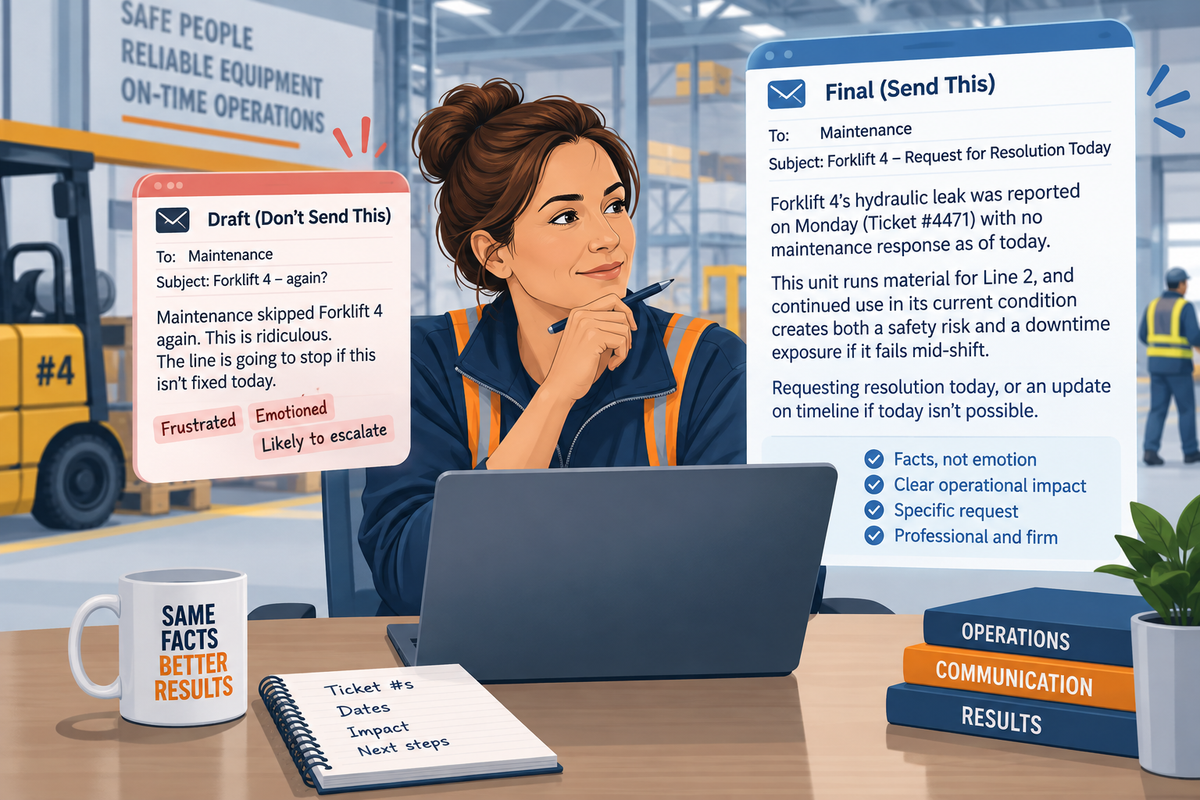
Maintenance ghosted Forklift 4's hydraulic leak for four days. You're tired, you're frustrated, and you need it fixed today, not next week.
The email you want to send would probably get you a meeting with HR. The email that gets the forklift fixed looks completely different. Most people never learn to write the second one under pressure.
Here's how to turn the first draft into the second one without losing the part that makes it effective: the fact that you're right.
Card 1: The Raw Frustration Draft
This is the version that exists in your head before anything gets typed.
"Maintenance skipped Forklift 4 again. This is ridiculous. The line is going to stop if this isn't fixed today."
Write this version first if it helps. Getting it out of your system matters.
Just don't send it. Don't skip straight past it either, because the frustration in it is where the real information is buried.
Card 2: The Calibrated AI Prompt
Feed the raw version to Claude or ChatGPT with instructions like this:
"Rewrite this with a firm, objective operational tone. Cite the safety risk, the downtime exposure, and the ticket history. Remove the emotion but keep the urgency. Don't soften it into something that sounds optional."
That last line matters. Most rewrite requests accidentally sand a message down until it reads as a gentle suggestion instead of a real problem. This instruction stops that from happening.
Card 3: The Final Communication
What comes back reads like this:
"Forklift 4's hydraulic leak was reported on Monday (Ticket #4471) with no maintenance response as of today. This unit runs material for Line 2, and continued use in its current condition creates both a safety risk and a downtime exposure if it fails mid-shift. Requesting resolution today, or an update on timeline if today isn't possible."
Same facts. Same urgency. Zero language anyone could screenshot and use against you later.
Why This Isn't Just "Being Nicer"
There's a real distinction in workplace communication research between assertive and aggressive tone. It's worth understanding rather than just imitating.
One breakdown of the difference lays it out cleanly: aggressive communication disregards the other person's position entirely, while assertive communication states the facts and the need plainly, without either attacking or softening into a suggestion.
The rewritten forklift email is the assertive version, not a watered-down one. It says exactly what's wrong and exactly what needs to happen. It just doesn't hand anyone a reason to focus on your tone instead of the actual problem.
The Accountability Rule
Every version of this email works better with two things attached: a timestamp and a ticket number.
"Maintenance is slow" is an opinion. Opinions are easy to dismiss.
"Reported Monday, Ticket #4471, no response as of Thursday" is a fact. Facts are a lot harder to wave off in a follow-up meeting.

Keep a running note of when you reported something and what reference number it got. That habit turns every future email like this into a thirty-second rewrite instead of a fresh fight.
Why the Rewrite Works Better Than the Original
The raw version feels satisfying to send. It rarely gets the forklift fixed any faster.
It tends to make the next request from you a little easier to dismiss too. A heated email is easy to file under "someone's having a bad day" instead of "real problem, needs action."
The calibrated version does something the raw one can't. It puts the reader in a position where ignoring it looks bad on paper, not just uncomfortable in a conversation.
That's the actual goal. Not sounding nicer. Getting the fix.
A Second Version, Different Department

Maintenance isn't the only source of this kind of friction. The night shift leaves a line running out of spec and doesn't flag it, and the day shift inherits the problem three hours in.
Raw draft: "Night shift didn't say anything about Line 3 running hot again. Found out the hard way an hour into my shift."
Calibrated: "Line 3 was running above the acceptable temperature range at the start of day shift, with no note in the handoff log. This created a quality risk on the first hour of production before it was caught. Requesting that temperature checks get added to the standard handoff checklist going forward."
Same shape, different department. Facts, risk, a specific ask, nothing anyone can dismiss as tone.
What Not to Let the Rewrite Do
A calibrated tone isn't the same as a vague one. If the rewrite starts using phrases like "when convenient" or "at your earliest opportunity," that's the tool softening urgency it was told to keep.
Push back on the draft the same way you'd push back on a person. "Make it more direct" or "add the deadline back in" gets a second pass that fixes it fast.
A Prompt You Can Reuse on Any Cross-Shift Friction
The same shape works whether it's maintenance, another shift, or a different department entirely:
"Rewrite this with a firm, objective tone. Cite the specific risk or cost of not acting, reference any ticket or timestamp I've provided, and keep the urgency without the emotion."
Swap in your own raw draft and your own specifics. The structure holds regardless of which department is on the other end.
When to Stop Emailing and Start Walking Over
Worth saying plainly: a well-written email is not a substitute for an actual conversation once something's been ignored twice.
If Ticket #4471 gets a second silence, the next move is a phone call or a walk to the maintenance shop. Not a third, even better-worded email.
The template above earns you a fair first shot at resolution through the normal channel. It's not meant to replace the moment when you decide the normal channel isn't working anymore.
The Floor Manager's $20 AI Stack covers which tool handles this kind of writing best if you're still deciding. Shift Notes to Shift Handoff: We Tested 3 AIs on the Same Messy Floor Notes picks up the same theme from a different angle, turning a full shift's worth of chaos into something the next person can use.
Comment below with the email you really wanted to send this week, and the one you sent instead.