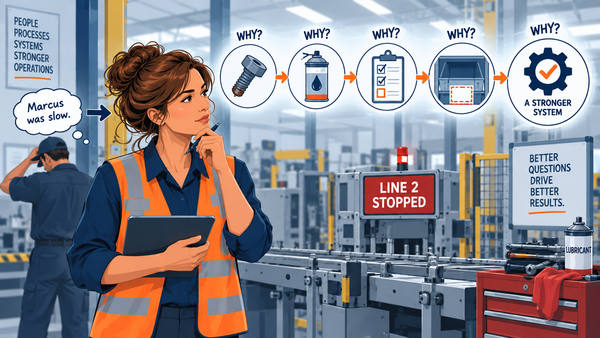
AI Read Your SOP. Too Bad Your Floor Doesn’t Follow It
AI can analyze your SOP perfectly and still give you the wrong answer if the documented process isn't what happens on the floor. Here's how to compare work-as-imagined with work-as-done before trusting the recommendation.

The SOP says the fastener check happens every hour, logged on the sheet by the press. Nobody's done it that way in eight months.
Everyone eyeballs the bin and tops it off when it's getting low, because the hourly check was written for a run rate the line hasn't hit since a machine upgrade nobody bothered updating the paperwork for.
Feed an AI tool the SOP. It optimizes a floor that stopped existing eight months ago.
Feed it the real floor notes instead. It might just as happily optimize the workaround, no questions asked, because nothing tells it that workaround was never approved by anyone with the authority to approve it.
Neither one is the truth by itself. That's the whole problem.
Your SOP and Your Floor Have Quietly Become Two Different Processes
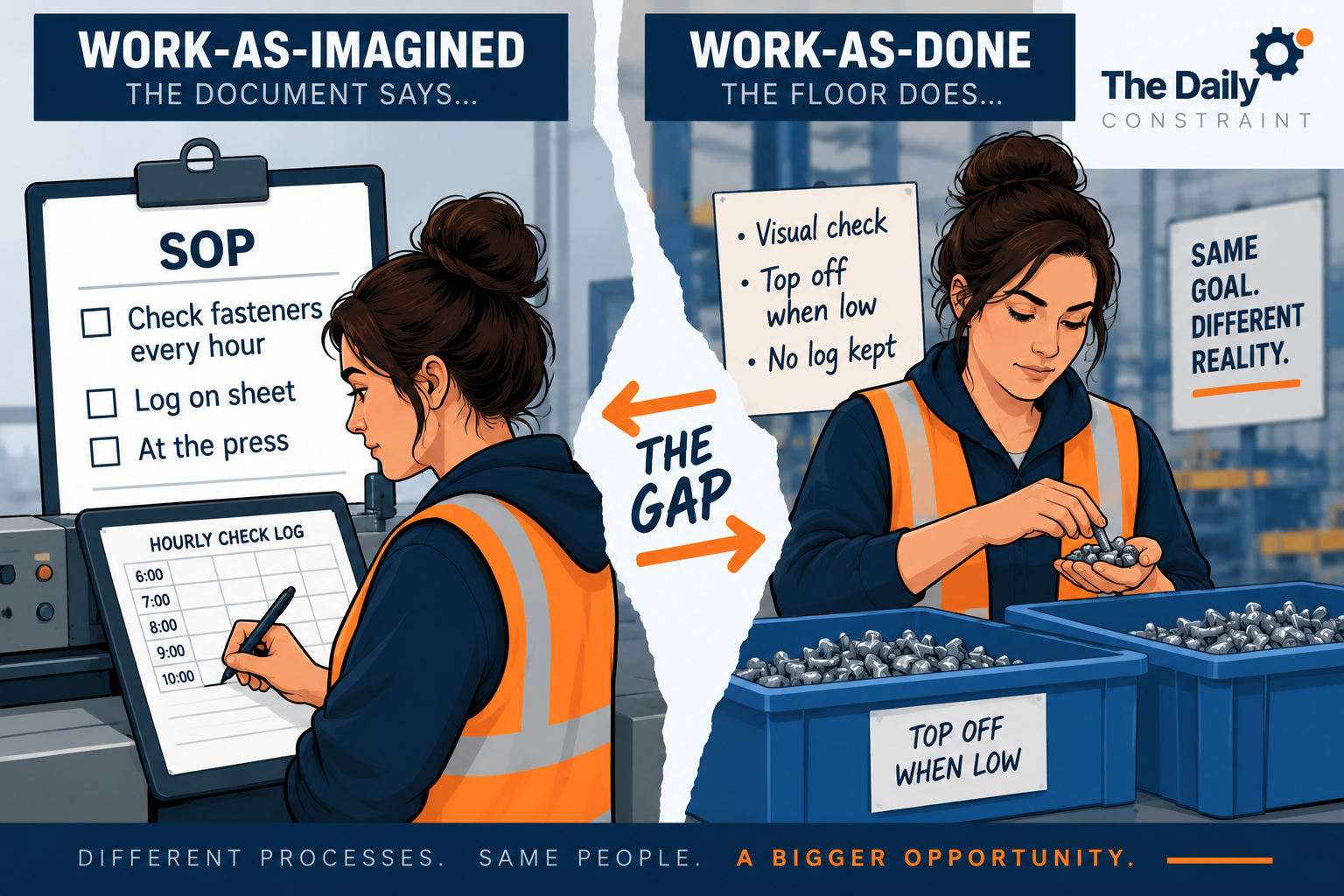
Safety researchers call this split work-as-imagined versus work-as-done, which is an academic way of saying the person who wrote the SOP has never run your line at ten minutes to end of shift.
Work-as-imagined is the flowchart. Work-as-done is whatever gets the job finished without anyone getting hurt or written up, built out of a hundred small decisions nobody wrote down because nobody thought to.
The distinction comes from resilience engineering, a field built largely on the work of Erik Hollnagel, who apparently needed a research career to confirm what every operator already knew for free.
Small gap, your SOPs are still roughly honest. Wide gap, and you're running two different rulebooks on the same floor and hoping nobody asks which one's real.
Why Feeding AI Just One Side Makes It Worse
Hand an AI tool only the SOP. It believes every word the way a brand-new hire believes the laminated sheet on the wall, right up until someone pulls them aside and says quietly, "yeah, we don't do it that way."
Any recommendation it builds sits on a step that isn't happening. Broken before it even leaves the chat window.
Hand it only the raw floor notes instead. It's gullible in the exact opposite direction. It has no idea the workaround was never blessed by anyone with the actual authority to bless it.
It optimizes the shortcut with the same straight face it would use on an approved procedure, because nothing in a casual description flags it as unofficial. Both mistakes look identical from the outside: a clean, confident answer that sounds like it knows what it's talking about.
Only one of them is standing on real ground. The output alone will never tell you which.
The Prompt: Make It Compare Both Versions

1. Set the Role
● Tell it to act as a process auditor whose only job is finding the gap between documented procedure and actual practice, not choosing a side or picking whichever version sounds more efficient.
2. Hand It the Data
● The written SOP, in full. The actual floor description of how the task really gets done, in the operator's own words if you have it.
3. Set the Constraints
● It must not treat either version as automatically correct. Every difference between the two gets flagged as a difference, not silently resolved in favor of one side.
4. Define the Output
● A side-by-side list of every point where the SOP and the real practice diverge.
● For each divergence, one line on the likely reason the gap exists: outdated documentation, a genuine safety workaround, or a shortcut that's probably just faster.
● A separate flag for any divergence that touches safety, quality, or anything regulated. Those don't get resolved by a chat window.
What Comes Back on the Fastener Example
SOP version
● Hourly fastener count, logged by hand at the press.
Floor version
● Visual check, topped off when the bin looks low, no log kept.
Likely reason for the gap
● Run rate changed after a machine upgrade. The hourly interval was calibrated to a slower line that no longer exists anywhere but on paper.
Flag
● Not safety-critical by itself, but the missing log means nobody has an actual record of fastener supply right now. That's worth a real decision, not whichever habit happens to already be in motion.
That last line is the entire point. Not "the SOP wins" or "the floor wins." A clear picture of exactly where the two drifted apart, so a real person makes the call instead of an AI tool quietly crowning a winner nobody asked it to pick.
A Second Example, Where Guessing Wrong Costs Something Real
Not every gap is as low-stakes as a fastener count. Say the SOP requires two people on anything over 40 pounds.
Nobody's standing around waiting on a second person when the line's backed up and the part just needs to move. So the floor version, built up over months by people who know their own backs, quietly became one person up to about 60.
SOP version
● Two-person lift required above 40 pounds, no exceptions noted.
Floor version
● Single operator handles up to roughly 60 pounds solo, based on the team's own read of what's manageable.
Likely reason for the gap
● Speed. Waiting on a second set of hands costs real time on a busy shift. Busy shifts don't reward waiting.
Flag
● This one doesn't get settled by comparing two documents. It's a real safety call that needs someone with actual authority to either enforce the original limit or formally change it. An AI tool has no business quietly picking either answer for you.
That's the version of this gap that matters most: the one where guessing wrong isn't a productivity hiccup, it's someone's back. No comparison prompt gets to make that call alone. Neither should you, without the right person in the room.
Not Every Gap Deserves the Same Attention
Run this comparison on a real floor and you'll surface a dozen small divergences in one pass, most of them harmless. Try to resolve all of them the same afternoon and you've just invented a project nobody finishes.
Sort what comes back into three piles. Safety and anything regulated go first, always, no negotiating.
Quality and customer commitments go second. Genuine efficiency shortcuts with no real downside can sit for now. Honestly, some of them deserve to get written into the SOP instead of stamped out just because nobody asked first.
The goal was never zero gaps. A floor with zero gap between what's written and what's real either has an unusually disciplined team, or more likely, nobody's looked in a long while.
Where This Connects
Feeding AI a clean document instead of messy reality is the same trap covered in Your AI Was Trained on the Happy Path. Your Floor Never Follows It., a tool optimizing the version of the process that exists on paper instead of the one that exists on the floor.
It's also worth reading alongside You Can't Automate a Process You've Never Actually Mapped, since the same gap that trips up an AI recommendation is exactly what trips up an automation project that skipped the mapping step to save a week.
Before You Trust Either Version
An SOP nobody checks against the real floor eventually turns into fiction with a company letterhead on it. Floor practice nobody checks against the SOP eventually turns into an unofficial standard that nobody with actual authority ever signed off on.
Run this comparison once a quarter, the same way a shift binder goes stale if nobody opens it. The gap will always exist. The only real question is whether it's still the gap you think it is, or whether it quietly became something else while nobody was looking.
Comment below with the last time your real floor practice and your official SOP had nothing to do with each other.