Your AI Needs Standard Work Too
A new operator gets handed a manual on day one. Ten steps, clear boundaries, exactly what to do if the machine jams, exactly who to call if the count comes up short.
Three stations down, a veteran does the same job differently. Faster, and it works.
He never wrote any of it down. He just decides, in the moment, when to handle something quietly and when to flag it.
That's fine, right up until he's out sick and the temp follows the manual exactly as written, and something breaks that never breaks under his method.
Standard work was never about killing judgment.
It's about writing down enough that the job survives someone else doing it.
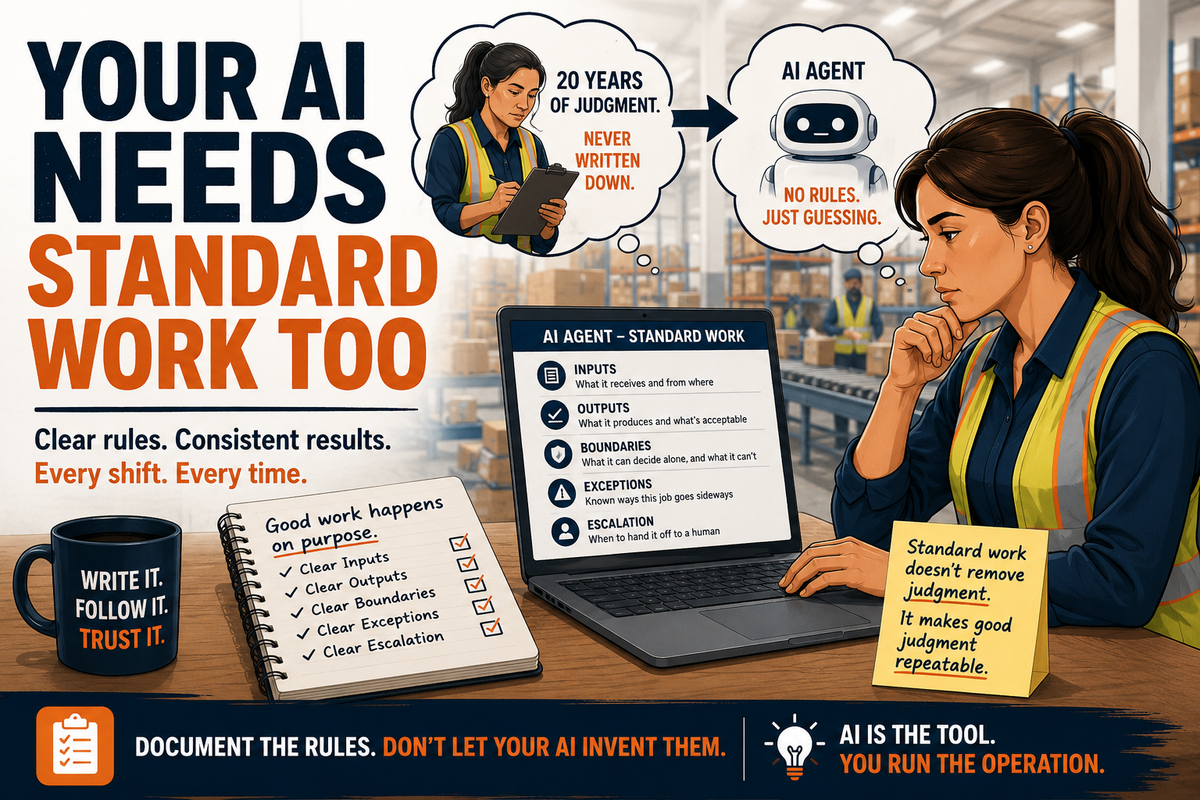
An AI agent running a task with no standard work is that veteran, minus the twenty years of instinct backing up the judgment calls, and minus the ability to explain any of it over coffee when someone finally asks.
Checkpoints tell a tool when to stop and ask. They don't tell it what to do the rest of the time. LINK: By the Time AI Asks Permission, It's Already Too Late.
What Standard Work Really Means
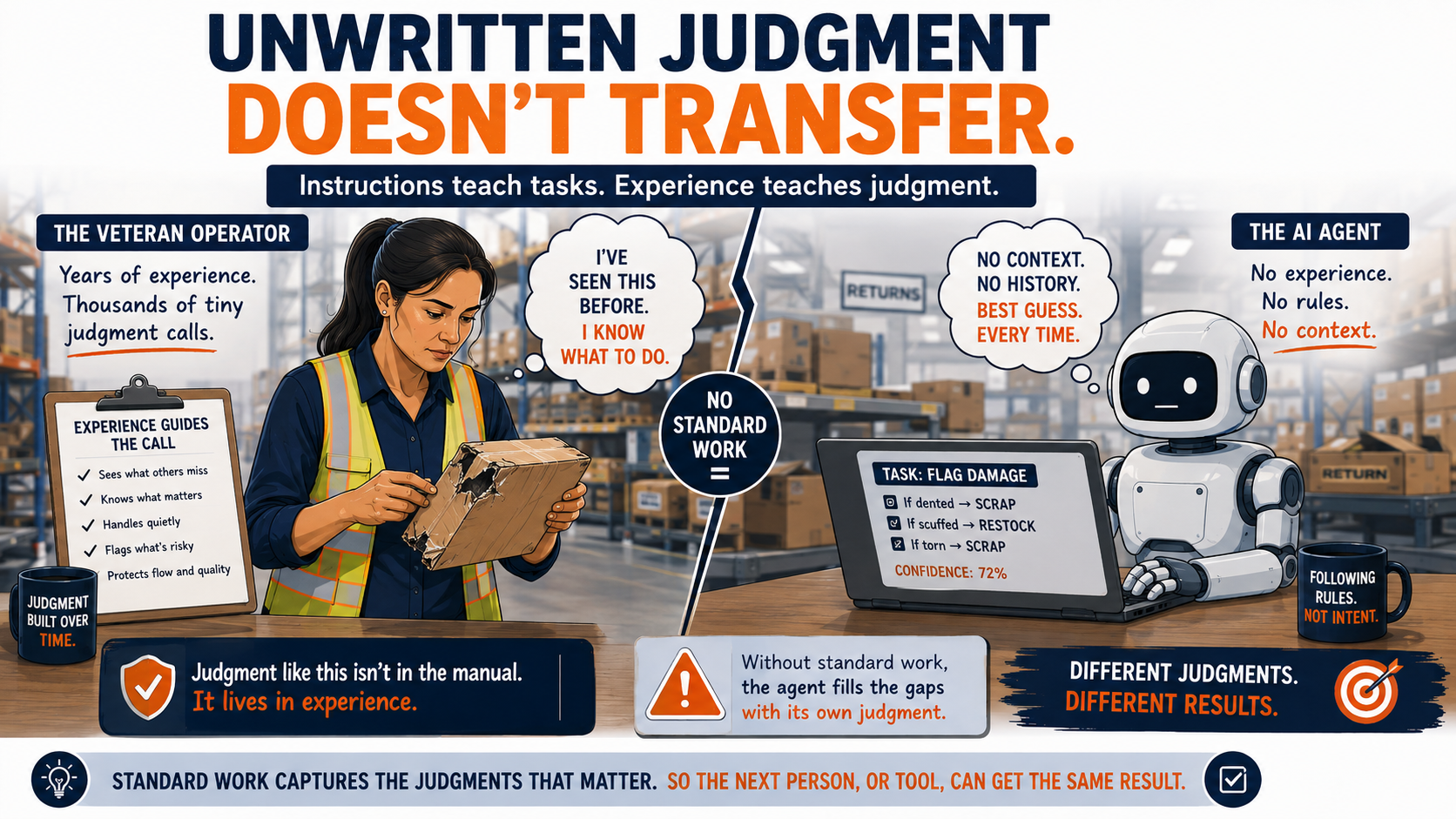
In Lean terms, standard work is the current best-known way to do a job, written down clearly enough that anyone trained on it gets the same result.
It's not red tape. It's the thing that keeps a job from quietly turning into ten different jobs, one per person doing it.
AI agents need the exact same discipline. Right now, most of them don't have it. They're improvising the undocumented judgment calls the same way the veteran does, except nobody can ask them why.
The Five Things Every AI Agent's Job Needs Written Down
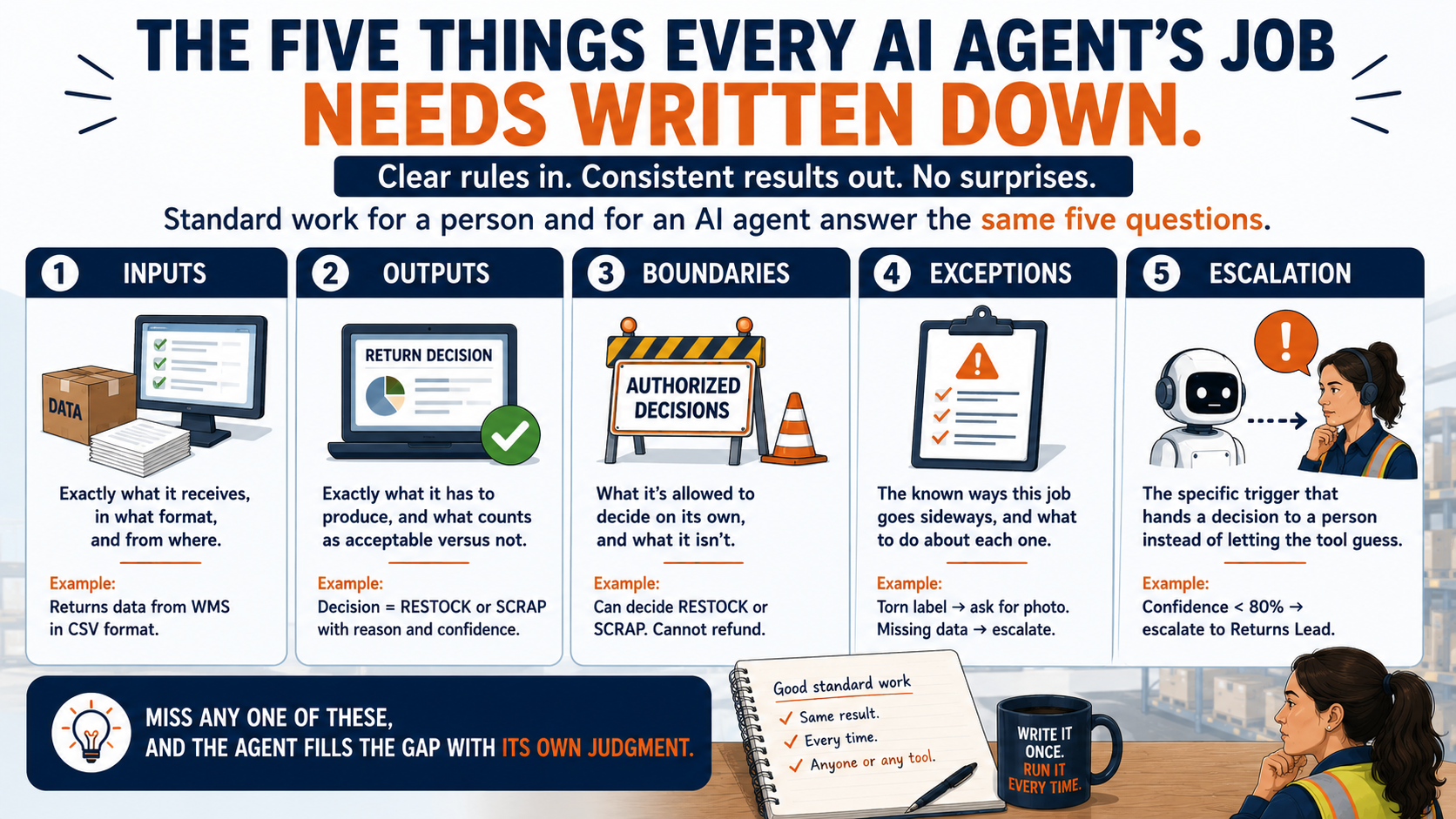
Standard work for a person and standard work for an AI agent both answer the same five questions.
● Inputs: exactly what it receives, in what format, and from where.
● Outputs: exactly what it has to produce, and what counts as acceptable versus not.
● Boundaries: what it's allowed to decide on its own, and what it isn't.
● Exceptions: the known ways this job goes sideways, and what to do about each one.
● Escalation: the specific trigger that hands a decision to a person instead of letting the tool guess.
Miss any one of these, and the agent fills the gap with its own judgment. That judgment becomes the new standard, whether anyone approved it or not.
The Same Discipline Behind a Good Shift Handoff
This is the same idea behind writing a clean end-of-shift handoff. A handoff works when the outgoing person writes down what the next person needs, not just a list of what happened.
Standard work for an AI agent is aimed at the same target. Whoever or whatever picks up the job next, human or another tool, needs the real operating rules. Not just a summary of what usually goes right.
The Prompt: Write Standard Work for Your AI Agent
Give an AI tool, Claude, ChatGPT, or similar, a plain description of the task you're handing to an AI agent. Ask it to help you build the standard work document before the agent ever touches a real task. Then adapt this prompt to your situation.
1. Define the Inputs Precisely
● Name the exact source, format, and any required fields for everything the agent will receive.
● Vague inputs are where a lot of undocumented judgment calls quietly start.
2. Define What “Acceptable” Looks Like for the Output
● Go further than “complete.” Describe what a genuinely good result looks like, and what a technically-finished-but-wrong one looks like.
● Ask it to give you one example of each, side by side.
3. Set the Boundaries of Its Authority
● List what the agent can decide on its own without asking, and where that authority stops.
● Example instruction: “Where in this task should the agent have to stop and ask, versus just proceed?”
4. List Known Exceptions and What to Do With Each
● Pull from real incidents where this kind of task has already gone sideways.
● Assign each one a specific response, not a general “use your best judgment.”
5. Name the Escalation Trigger and Who It Goes To
● Have it write the exact condition that hands a decision to a person, and name that person by role.
● A vague escalation path is the same as no escalation path once things get busy.
Five steps, and the document that comes out the other end is the same thing you'd want for a brand-new hire on their first week. The agent just happens to not need the coffee break to go with it.
What AI Can't Standardize for You
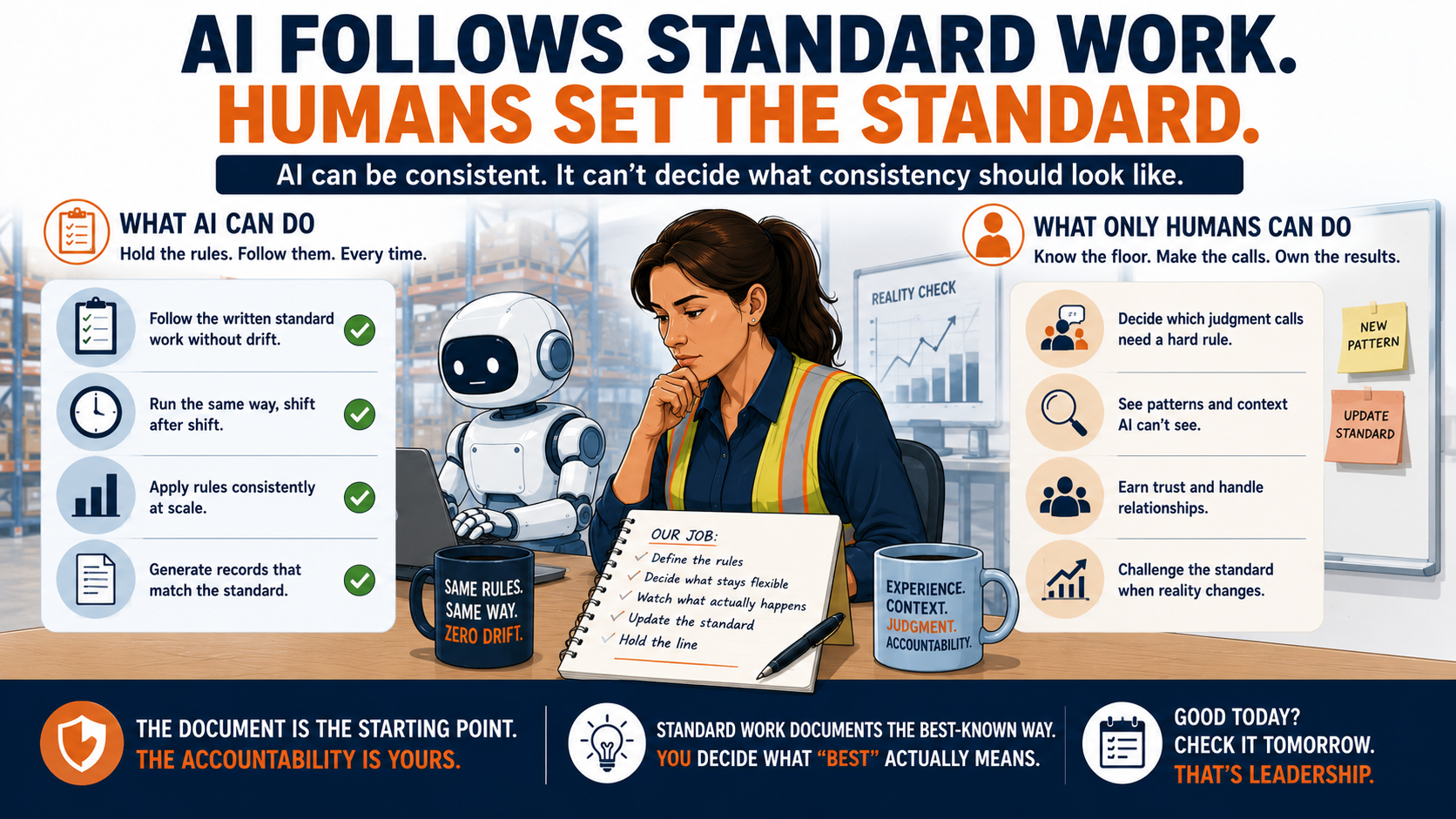
AI can hold a standard work document and follow it consistently, shift after shift, without drift.
It can't decide which judgment calls are fine to leave flexible and which ones need a hard rule. That call comes from knowing your floor, not from reading a document.
It also can't build the trust a veteran earns over twenty years just by writing everything down once.
The document is the starting point. Watching whether it holds up is still yours.
What Happens When the AI Has to Make the Call?
Give an experienced operator an incomplete procedure and they may know how to fill in the gaps.
Give an AI agent the same incomplete instructions and it will fill in the gaps too. The difference is that experience isn't making the call.
This short Constraint File shows why an AI agent needs standard work before the exception shows up.
Next Up in This Category
Say the standard work is written, the boundaries are clear, and the checkpoints are in place.
How do you know if any of it is working? Next, we look at the difference between a process that feels fine and one that's measurably fine. LINK: Your Automation “Feels” Like It's Working. That's Not a KPI.
Subscribe to The Daily Constraint if you want it the day it goes live.
Does your AI tool have real standard work written down, or is it improvising the judgment calls the same way your best veteran does? Tell me which one.