How Can Operations Managers Use AI to Translate Precise Instructions for Employees Who Speak Little English?
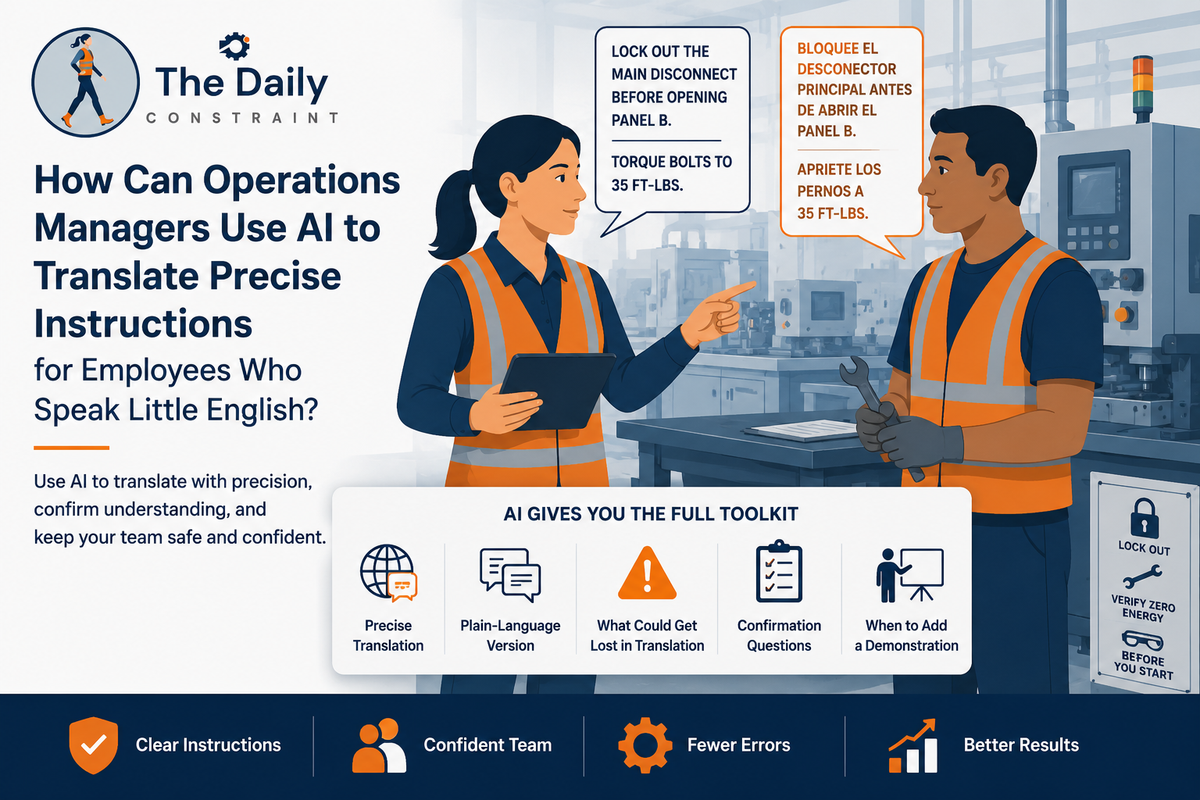
This is the sixth and final post in our six-part series on becoming an irreplaceable operations manager. Last time, we covered finding a fast, safe workaround the moment a process breaks down mid-shift. This post takes on the sixth and final item on our list: giving precise instructions to employees who speak little English, without losing the precision along the way.
Somewhere on your floor right now, someone is nodding along to instructions they didn't fully catch, because nodding is faster than admitting they're lost, and admitting you're lost in front of the boss is its own kind of exhausting.
You've got your own version of sign language for this. Point at the machine. Point at your eyes. Mime turning a valve like you're wringing out a towel. It's not a language. It just feels like one by the third time you've done it before lunch.
Cute, until the instruction involves a torque spec, a chemical, or a lockout procedure, and “sort of understood” turns into an incident report.
This is where AI earns its keep. Not because it can translate a sentence, Google Translate has done that for years. Because it can help you translate precisely, catch what doesn't survive the trip between languages, and hand you a way to check that your message truly landed.
Give AI the Instruction, Not Just the Words
You already know the four-part prompt structure from earlier in this series: role, data, constraints, output. For a translation, the instruction itself is the data, and precision is the constraint. Feed AI a loose paraphrase and it hands back a loose paraphrase in another language, which is exactly the problem you started with. Just now in two languages instead of one.
Before you open the chat, get clear on four things:
• The exact instructions, word for word, the way you'd say it when precision matters. It does.
• The target language.
• Anything that must stay exact and never get smoothed over: measurements, chemical names, torque specs, safety terms.
• Whether the person is more comfortable with written instructions or a demonstration paired with a shorter written summary.
The Prompt
Give it the instruction and the stakes, and let it handle the careful part:
You are a precise technical translator helping an operations manager communicate a safety-critical or process-critical instruction to an employee whose first language is [target language]. Precision matters more than fluency here. Do not simplify or paraphrase away technical detail.
Here is the exact instruction: [paste the instruction].
Here are the terms that must stay exact and not be softened or approximated: [measurements, chemical names, safety terms].
Structure your output using the exact sections below:
1. FULL TRANSLATION
- A precise, technically accurate translation of the instruction, preserving every term I flagged as exact.
2. PLAIN-LANGUAGE VERSION
- A second, shorter version of the same instruction in plain, everyday language, stripping out anything that reads like corporate or technical boilerplate, without losing any of the exact terms I flagged.
3. WHAT COULD GET LOST IN TRANSLATION
- Any word or phrase in my instruction that doesn't have a clean equivalent in this language, or that's commonly mistranslated, and why.
4. CONFIRMATION QUESTIONS
- Two or three questions I can ask, in the target language, that confirm the person fully understands the instructions. Not “do you understand,” something that requires them to repeat back a specific detail.
5. WHERE WORDS AREN'T ENOUGH
- Note whether this instruction is the kind that needs a demonstration or diagram alongside the translation, and why.
Do not guess at a translation you're not fully confident in. Flag it instead.
You're Still the One Who Confirms
AI can translate the sentence. It can catch the tricky phrase and hand you three sharp confirmation questions in the right language. What it can't do is watch the person's face when they answer, notice the half-second pause before “yes,” or know that this particular operator learns by watching your hands, not by reading anyone's sentences, in any language.
Go back to the first post in this series again. You know the people on your team. That instinct doesn't get replaced by a better translation. It gets a better translation to work with.
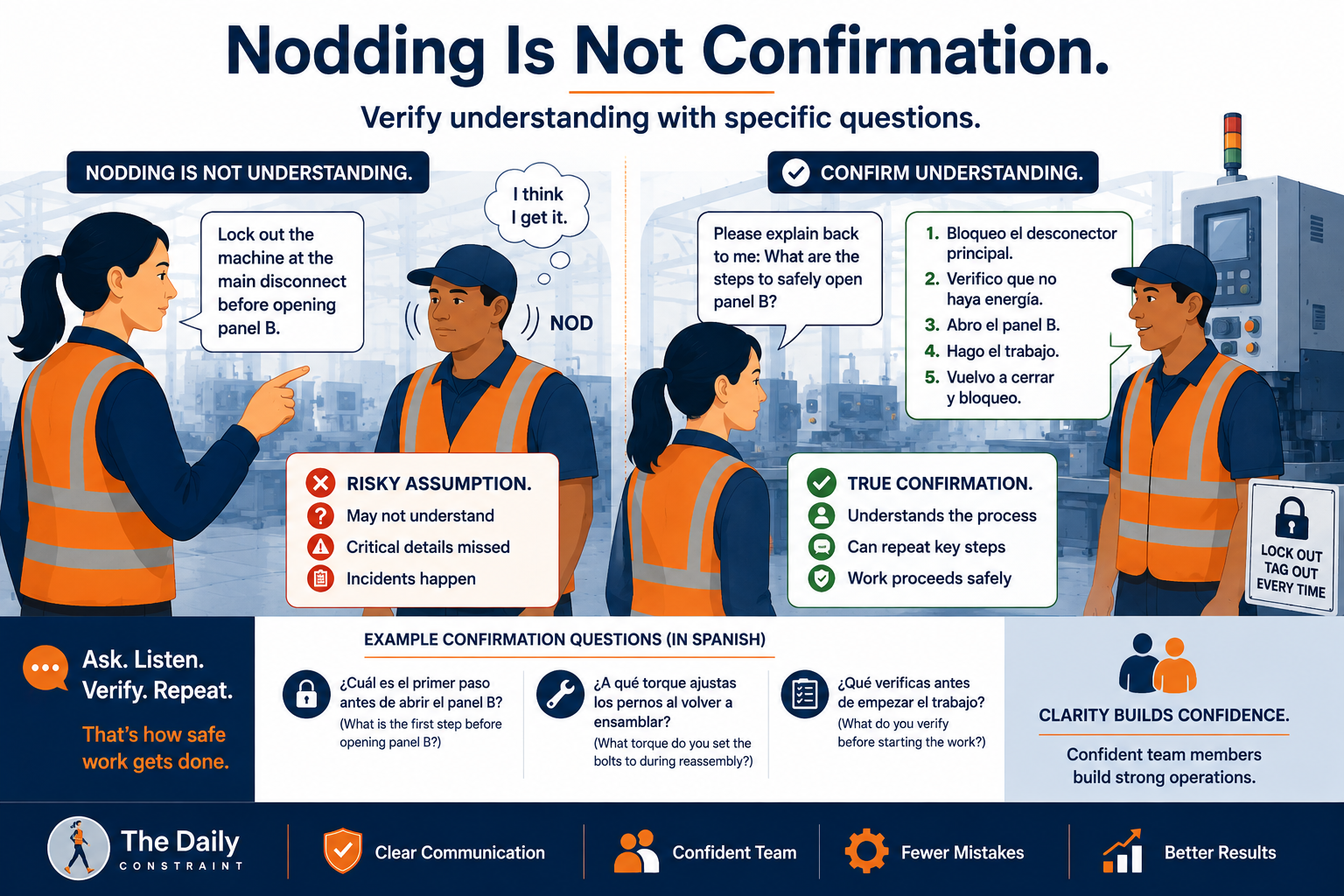
Nodding is not confirmation. A correct answer to a specific question, in the person's own words, is.
When a Demonstration Beats a Sentence
Some instructions don't survive as text no matter how good the translation is. Torque specs. The exact feel of a valve at the right resistance. The sound a machine makes right before it's about to jam. None of that critical information transfers through words alone, in any language. That's not a knock on the person you're training. It's just what the instruction requires.
That's what section five of the prompt is for. Pair the translated card with you physically doing the motion once, and the translation stops being the whole lesson and starts being the reference they check afterward.
And if your one bilingual team member has become the unofficial interpreter for every hard conversation on the floor, that's worth naming out loud. A good prompt can take the routine translations off their plate. It can't replace the actual trust that made them the person everyone goes to in the first place.
What Comes Back
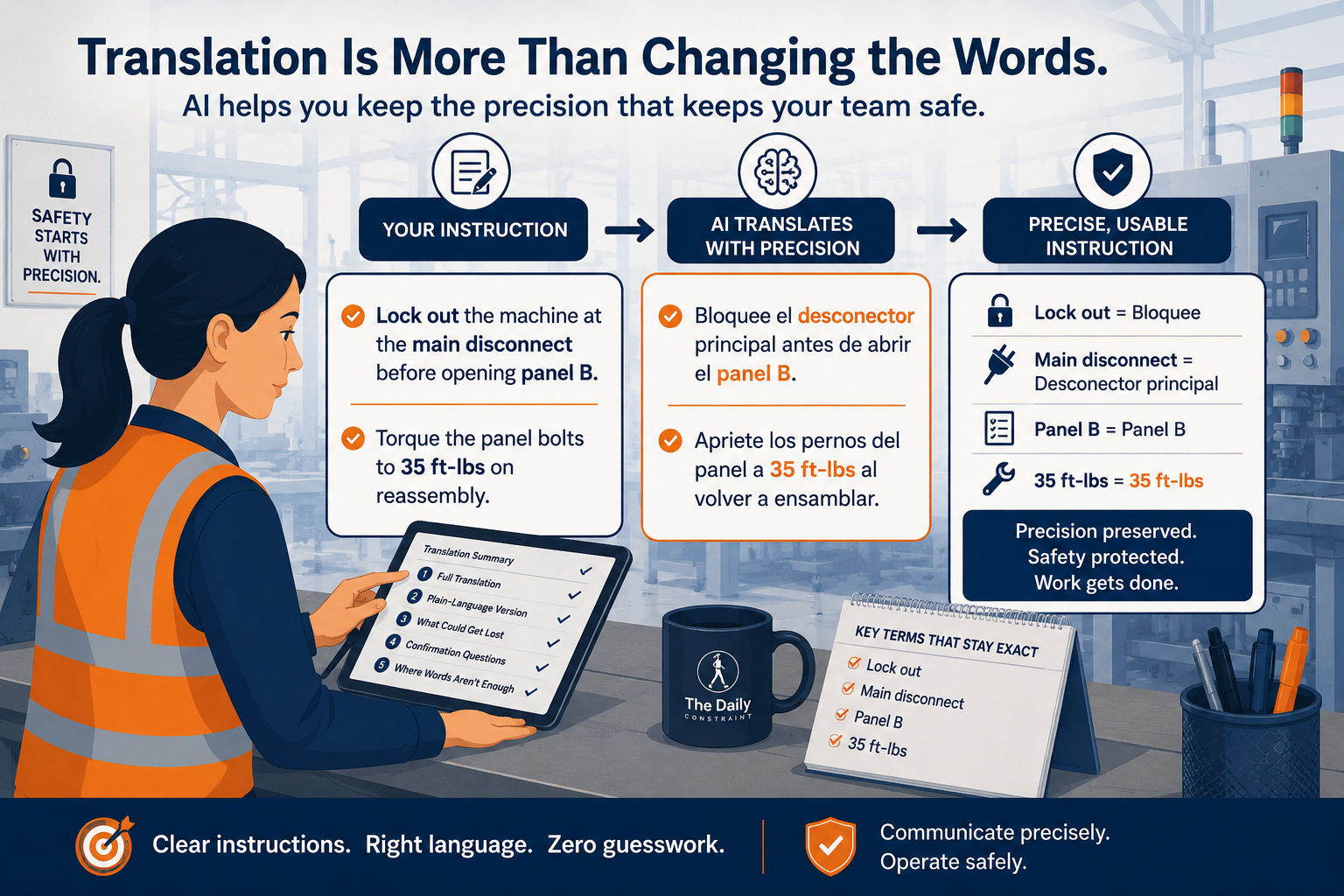
Say the instruction is this: “Lock out the machine at the main disconnect before opening panel B. Torque the panel bolts to 35 ft-lbs on reassembly.” Target language, Spanish. Flagged terms: lockout, main disconnect, panel B, 35 ft-lbs. Here's roughly what comes back.
• FULL TRANSLATION: “Bloquee la máquina en el desconectador principal antes de abrir el panel B. Apriete los pernos del panel a 35 pies-libra durante el reensamblaje.”
• PLAIN-LANGUAGE VERSION: Same numbers, same terms, stripped of the corporate phrasing (“prior to reassembly” becomes “before you put it back together”).
• WHAT COULD GET LOST: “Ft-lbs” doesn't translate cleanly and can get mixed up with metric torque units. Worth showing the number on the wrench itself instead of relying on the spoken unit.
• CONFIRMATION QUESTIONS: “What number do you set the torque wrench to?” instead of “do you understand?”
• WHERE WORDS AREN'T ENOUGH: This one's worth demonstrating once. Torque is hard to verify by ear or by translation alone.
One instruction, translated twice, with the one weak point in the whole exchange flagged before it became a problem instead of after.
Fine-Tune It Fast
If the first draft doesn't fit the person you're talking to, say so:
• “Simplify the plain-language version further. Strip out any remaining jargon.”
• “Give me the confirmation questions as something I can ask without an interpreter in the room.”
• “This term has a specific meaning on our floor, different from the dictionary definition. Here's what it literally means: [explain]. Retranslate with that context.”
• “Turn the confirmation questions into something I can post next to the machine, not just ask out loud.”
The floor-specific meaning correction matters more than it looks. Every plant has a handful of words that don't mean what the dictionary says they mean. AI only learns yours if you tell it.
The Whole Toolkit, in One Place
Six posts back, the question was whether AI is coming for your job. The question you should be asking is this: how do you use AI to make yourself irreplaceable?
Six ordinary tasks that eat your day in small pieces, one prompt apiece: turning notes into a to-do list, reaching three audiences with one update instead of three rewrites, asking Gemba questions sharp enough to find a real cause, closing the loop on a shift handoff in both directions, deciding fast and safely when something breaks, and now, making sure a precise instruction survives the trip into someone else's first language.
None of these replace your judgment. Every one of them gives you back the time and clarity to use that judgment on the things AI genuinely can't touch: the person, the floor, the fifteen years of pattern recognition nobody wrote down anywhere.
That's the whole game. Comment below and tell me which of these six you're going to use tomorrow morning. Not bookmark. Use. And how it worked out for YOU!
Subscribe to TheDailyConstraint if you haven't already and come back often for new ways to use AI as a tool in your operations journey. Operations managers are not likely to be replaced by AI anytime soon. However, you can USE AI to help make you someone your organization will find to be irreplaceable. The Daily Constraint can help!