Can AI Help You Get More Production from the Same 10-Hour Shift?
Your shift isn't getting any longer. Learn how AI can help you analyze problems, organize information and reclaim time for the work that actually requires you.
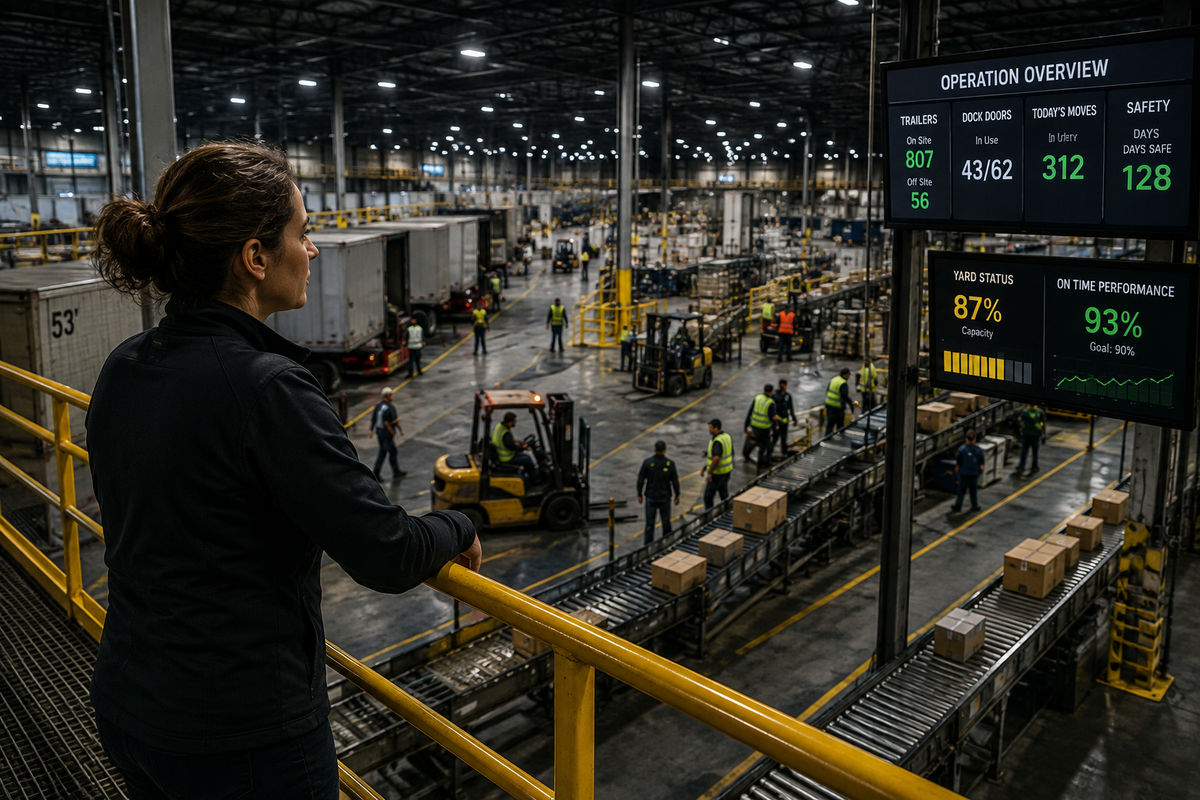
You walk into your shift with a plan.
You know the volume. You know the headcount. You know what yesterday missed and where today's trouble spots are likely to be.
For approximately seven minutes, everything looks great.
Then operations happens.
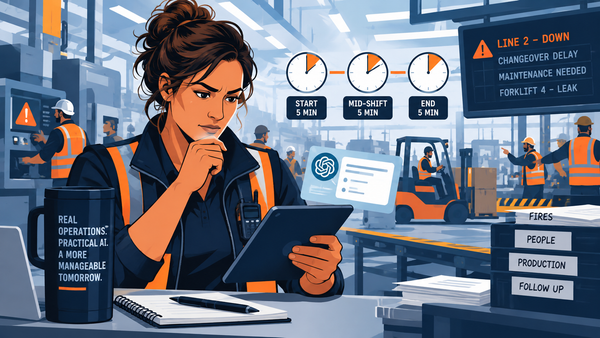
Someone calls out. A process starts falling behind. Equipment goes down. Quality starts moving in the wrong direction. Someone needs an answer about yesterday's miss. Your labor plan needs to change. There's a meeting in 20 minutes, and you'd really like to know what caused the problem before you're expected to explain how you're going to fix it.
By lunch, you've pivoted so many times your hair feels like it's on fire from the friction.
Welcome to operations.
Your Operation Has a Constraint. So Do You.
You spend your shift thinking about capacity.
How many people do you have? How many labor hours? How much volume? What's your expected rate? Where's the bottleneck? What can you move, change, eliminate, or improve to get more from the resources available?
But there's another finite resource affecting your operation every day.
YOUR time.
You get the same 10 hours whether everything runs beautifully or the building appears determined to test your commitment to operational leadership as a career choice.
And some days, those hours disappear remarkably fast.
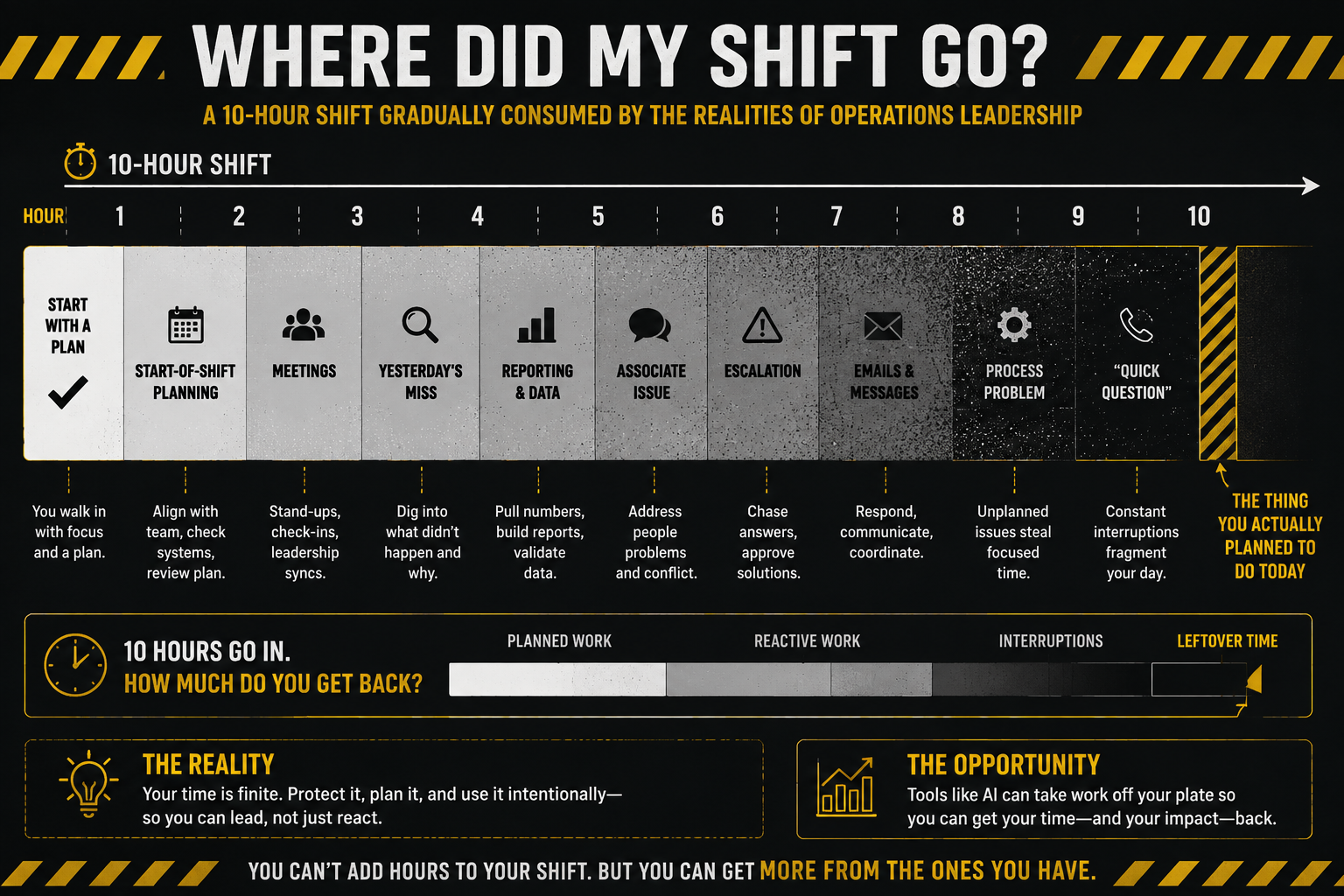
You still need to:
- Investigate yesterday's misses.
- Understand today's numbers.
- Find bottlenecks.
- Analyze problems.
- Explain findings.
- Coach your people.
- Follow up on corrective actions.
- Work on process improvements.
- Learn whatever new metric, system, process or methodology landed in your lap this week.
Oh, and presumably run the operation.
Wouldn't want to forget that part.
Enter AI. But Keep Your Cape.
There is plenty of content online right now suggesting AI can do practically everything short of unloading the trailer for you.
It can't.
There are operational problems AI simply cannot solve.
AI cannot walk your floor.
It can't hear the strange noise coming from a machine that supposedly has nothing wrong with it.
It can't notice a queue forming where your dashboard says everything is fine.
It doesn't know that your highest-performing associate quietly developed a better method three months ago.
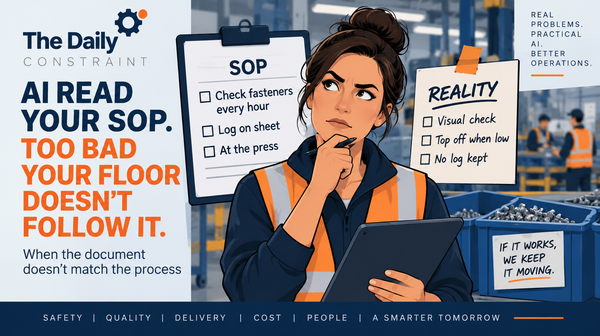
It doesn't know that everyone ignores Step 7 of the standard work because Step 7 makes absolutely no sense in the real world.
It doesn't know your operation.
YOU do.
REALITY CHECK
AI is a tool. It isn't Gemba. It isn't judgment. It isn't leadership. And a beautifully formatted answer based on bad information is still a bad answer.
So why am I building an entire publication about using AI in operations?
Because AI doesn't have to replace your expertise to make YOUR expertise more valuable.
The Opportunity Is in the Hours Between the Fires
Think about how much time you spend on the work surrounding the work.
You collect information.
You compare numbers.
You research something you don't understand.
You organize observations.
You prepare for meetings.
You turn findings into explanations.
You rewrite the same information for different audiences.
You try to build a coherent case for an improvement you've known for three weeks needs to happen.
Individually, these tasks don't create unreasonable time crunches.
Collectively?
There went Tuesday.
This is where learning to work effectively with AI starts getting interesting.
What Can AI Actually Help You Do?
Used well, AI can help you:
- Analyze problems faster. Organize what you know, explore potential causes, challenge assumptions and determine where to investigate next.
- Get more from operational data. Ask better questions, compare information and look for patterns worth investigating.
- Investigate bottlenecks. Work through process steps, queues, cycle times and constraints to narrow your focus.
- Structure root-cause analysis. Turn a pile of observations into an organized investigation.
- Develop improvement ideas. Explore alternatives, anticipate unintended consequences and identify what you need to measure before testing a change.
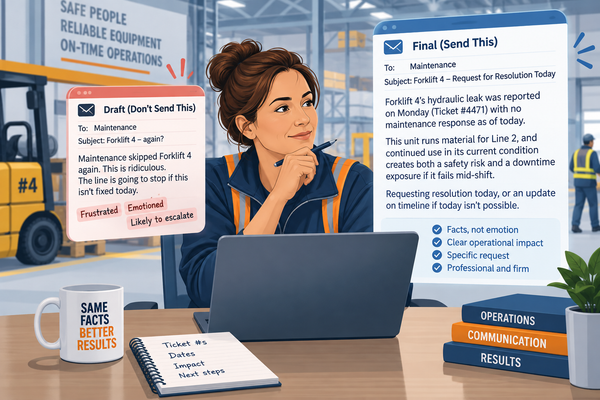
- Communicate your findings. Turn your analysis into a clear update, proposal, presentation, action plan or training document.
- Learn faster. Get help understanding unfamiliar metrics, calculations, Lean concepts, Six Sigma tools or process-improvement methods when you actually need them.
There is something deliberately missing from that list.
Let AI make the decision.
That's still your job.
What If You Could Buy Back 75 Minutes?
Imagine three tasks on a particularly busy day.
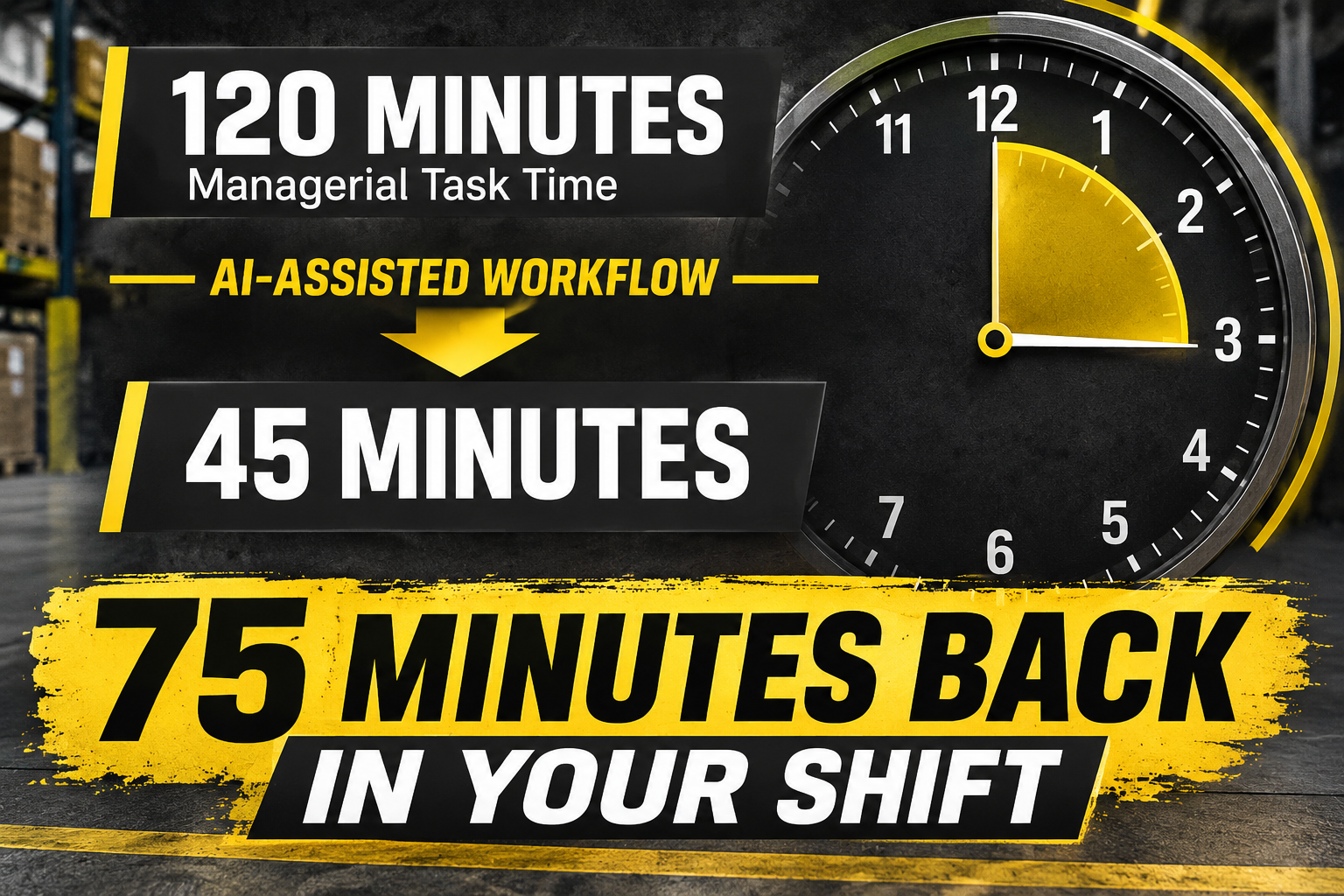
- Analyze yesterday's miss: 60 minutes → 25 minutes with AI
- Organize findings for a meeting: 30 minutes → 10 minutes with AI
- Draft an action plan: 30 minutes → 10 minutes with AI
Without AI assistance: 120 minutes
With AI assistance: 45 minutes
That's 75 Minutes Back in Your Shift.
Those numbers are illustrative, not a promise of specific productivity gains. Your results will depend on the task, the information available and how effectively you use AI.
AI hasn't added a single minute to your shift.
It hasn't produced another unit.
It hasn't coached an associate.
It hasn't fixed the process.
It HAS removed some friction from your day.
And that raises a much more interesting question.
What Could You Do With 75 More Minutes?
You could walk the process you've been meaning to observe.
Coach the associate who needs more than a hurried conversation in passing.
Follow up on yesterday's corrective action.
Investigate the bottleneck everyone keeps working around.
Talk to the people actually doing the work.
Test an improvement.
Look behind the metric instead of spending all your available time reporting the metric.
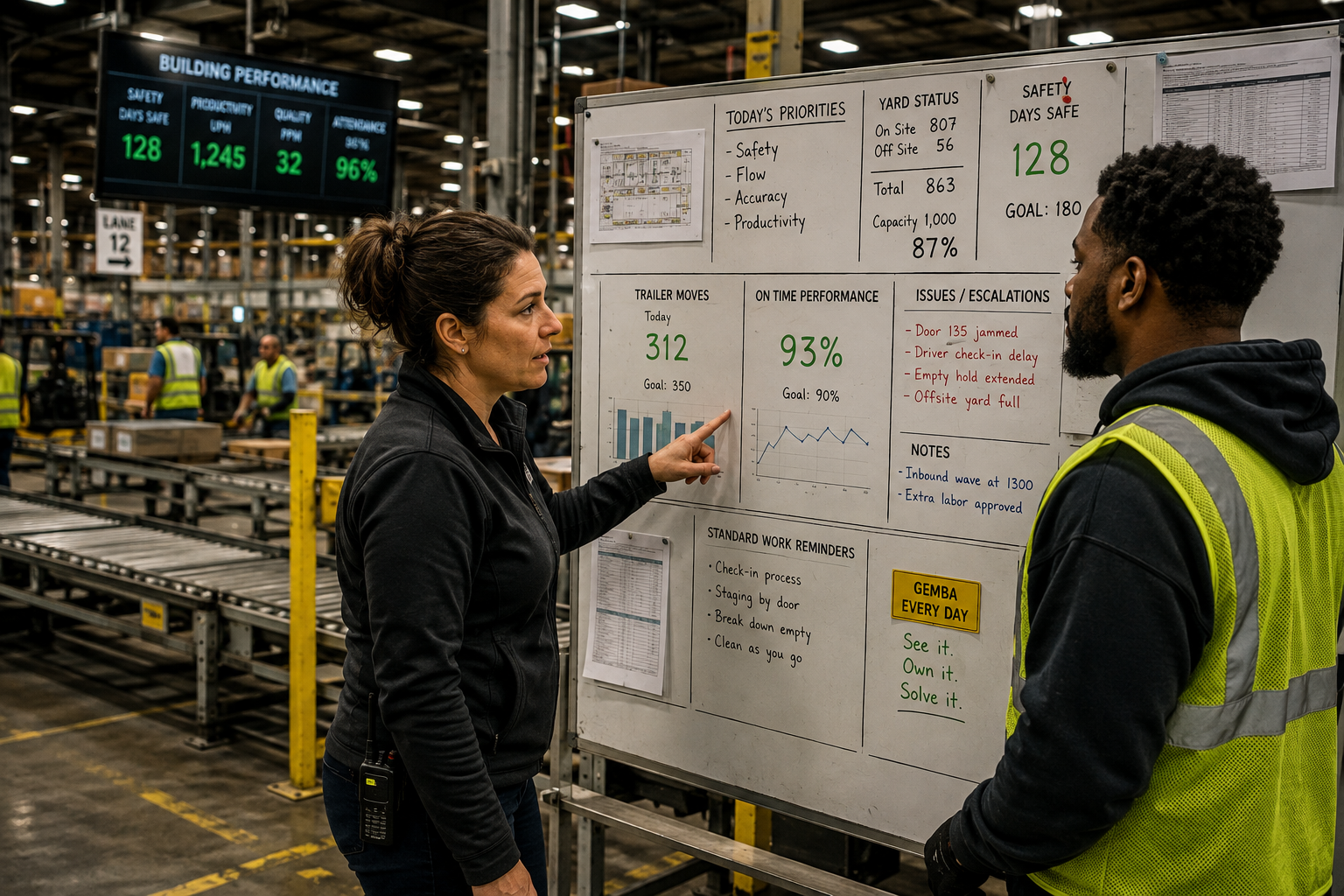
That's where AI can begin affecting operational results.
Not because the chatbot produced another widget.
Because the operations manager had more time to improve the system that did.
There's a Catch
Of course there is.
If AI automatically gave everyone who opened an account another 75 productive minutes every day, this would be a very short article.
The quality of what you get from AI depends heavily on how you work with it.
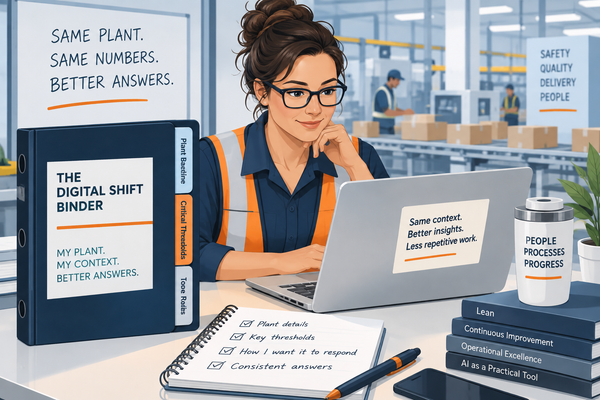
You need to know what information matters.
You need to provide context.
You need to recognize when an answer doesn't make sense.
You need to protect sensitive information.
You need to verify important conclusions.
Most importantly, you need to know when AI is the wrong tool for the problem.
Those skills improve with practice.
And as you get better at working with AI, you can begin finding more practical places to use it throughout your shift.
Not because you need to become an AI expert.
Because you want to become better at operations.
That's Why The Daily Constraint Exists
I'm not particularly interested in AI for the sake of AI.
I'm interested in what happens when you put a powerful new tool into the hands of someone who understands operations and teach them how to use it well.
That's what we're going to explore here.
We'll look at practical ways you can combine AI with:
- Lean.
- Continuous improvement.
- Gemba.
- Six Sigma.
- Root-cause analysis.
- Theory of Constraints.
- Standard work.
- Operational data.
- And the experience and judgment you've already developed by actually doing the work.
Sometimes AI will be useful.
Sometimes it won't.
We'll talk about both.
Because the question isn't:
"What can AI do?"
The question that matters here is:
Can This Actually Help You Run a Better Operation?
That's the standard.
You aren't getting another two hours added to your shift.
Your labor hours aren't magically multiplying.
And tomorrow will undoubtedly arrive with an entirely new collection of problems nobody bothered to put in today's plan.
But you can get better at using the resources available to you.
Your own time is one of them.
Subscribe to The Daily Constraint and we'll keep exploring practical ways to use AI to understand your operation, solve problems, improve processes and get more accomplished with the hours you already have.
After all, you've got enough fires to put out.
Figuring out which AI tools are actually worth your time shouldn't be another one.